Most Enterprises Have AI Agents in Production, but Value Still Lags
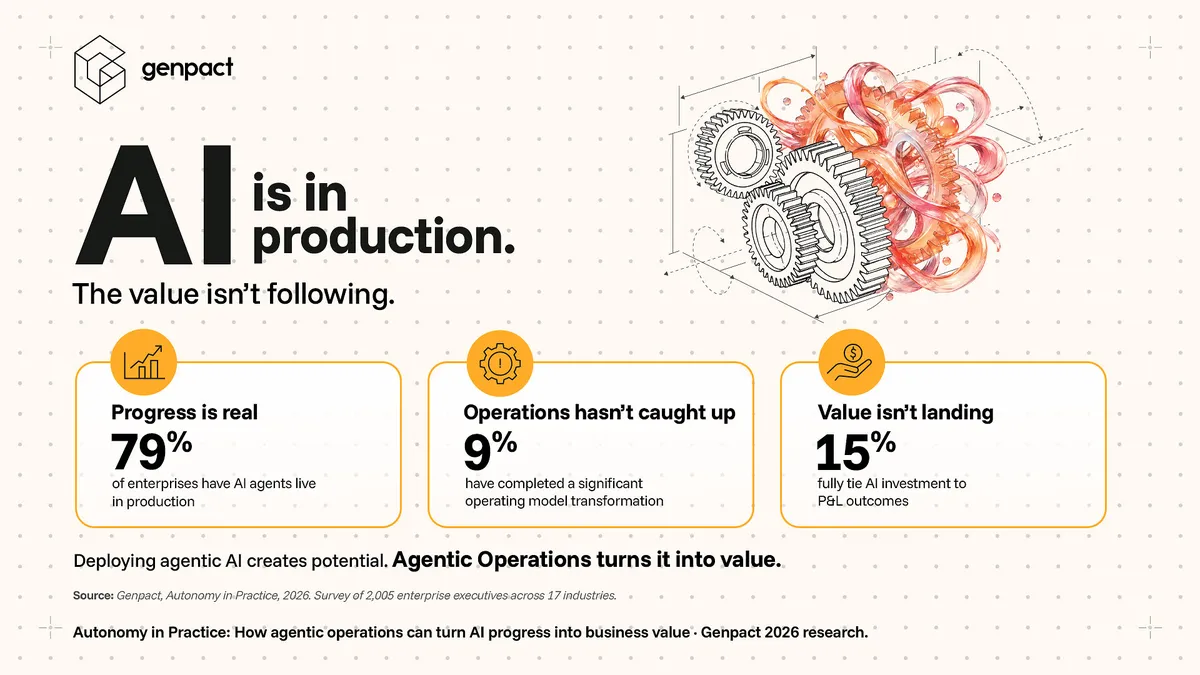
AI agents have reached production at 79% of surveyed enterprises, but only 15% have fully connected AI investment to P&L outcomes, according to a Genpact report. The findings suggest that operational change, rather than deployment alone, is the main barrier to converting AI progress into business value.
- 79% of surveyed enterprises have AI agents in production.
- Only 15% have fully tied AI investment to P&L outcomes.
- Just 20% use agents broadly and consistently across functions.
- AI now leads or fully runs 40% of decisions.
- 92% of enterprises with agents in production kept or grew their human workforce.
AI deployment is moving faster than operating change
Genpact published its Autonomy in Practice: How agentic operations can turn AI progress into business value report on Nov. 12, based on a 2026 survey of more than 2,000 senior executives. Respondents represented companies with annual revenues from $1 billion to more than $50 billion, across 17 industries and 14 business functions. The research was supplemented by in-depth interviews with enterprise leaders.
Although 79% of enterprises surveyed have AI agents in production, only 20% use them broadly and consistently across functions. Just 49% of AI initiatives funded during the past 24 months have delivered the value expected, on average. Only 9% of respondents said their organizations had completed significant operating model transformation.
Genpact describes the missed business benefit as the “autonomy dividend,” meaning the value created when AI-enabled gains improve business performance rather than simply increasing productivity. The company says the findings show that enterprises have deployed agents faster than they have redesigned the way work is organized.
Human oversight remains central as agents scale
AI now leads or fully runs 40% of decisions, according to the survey, more than double the share reported a year ago. However, humans still decide or audit in at least 87% of cases at every decision stage.
The results also indicate that agent deployment is not generally being associated with a smaller workforce. Among respondents with agents in production, 92% said they had kept their human workforce the same size or grown it. Genpact interprets this as evidence that practical autonomy involves defining where agents act, where people make or validate decisions, and which outcomes the combined workforce is responsible for.
“Enterprises have become effective at deploying AI agents. Running them is the hard part,” said Sanjeev Vohra, Genpact's Chief Technology and Innovation Officer. “Agentic Operations connects AI with context-rich process intelligence, human judgment, and governance to capture the autonomy dividend.”
What Genpact's AI Leaders do differently
Genpact identifies the top 17% of enterprises in its AI Maturity Index as “AI Leaders.” The company says these organizations are further along in building Agentic Operations, its proposed operating model for running people and agents as one workforce.
According to Genpact, AI Leaders have a CEO-level mandate and are ahead across five building blocks. They reinvent work across the enterprise instead of changing one function at a time, create roles such as exception specialists and agent trainers, and strengthen data and AI foundations so agents can act across systems rather than only retrieve information.
They also govern and secure agents throughout their lifecycle, not only at deployment. Finally, they treat value capture as a P&L discipline by connecting AI-enabled gains to named owners and P&L lines. For users and enterprise buyers, the report frames the next stage of AI adoption as a management and operating challenge, with measurable ownership and human oversight needed alongside agent deployment.