AI Weather Models Forecast Unprecedented Dubai Rainfall by Learning From Other Regions
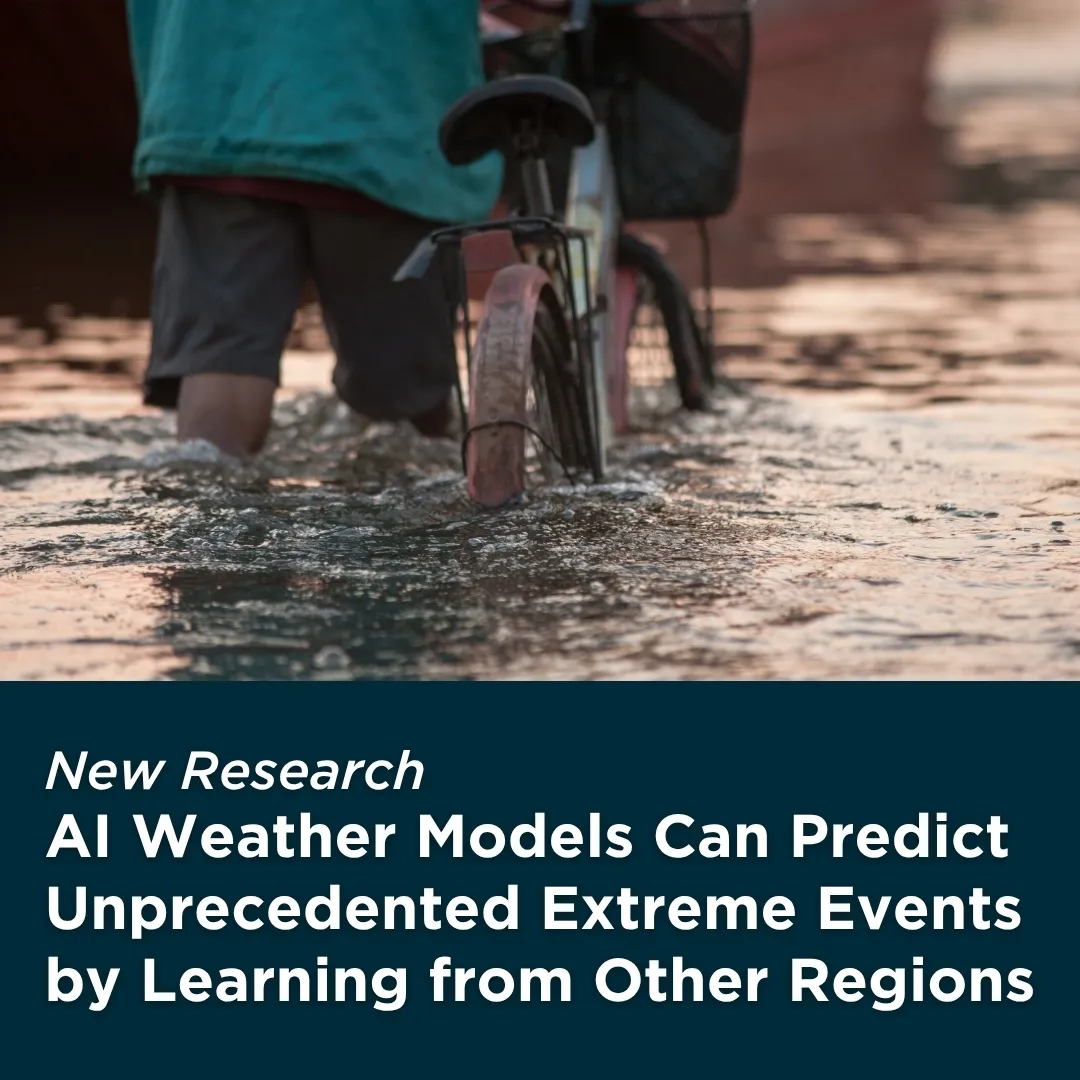
A new study in Science Advances finds that AI weather models can forecast extreme rainfall that exceeds anything in their training data. Researchers at the University of Chicago say the models appear to do this by learning from similar events in other parts of the world.
- A Science Advances study tested three AI weather models on the April 2024 Dubai extreme rainfall event.
- All three predicted the event's timing and location five days ahead, though peak rainfall was twice the highest in their training sets.
- Two models estimated rainfall amounts fairly well, while the third significantly underestimated them.
- The analysis suggests the models learn from similar strong events in other regions, which the team calls translocation.
- All three models severely underestimated the strongest global extreme precipitation events, with spectral bias identified as one cause.
Dubai rainfall tested three AI models
The study examined how three AI models handled an April 2024 extreme rainfall event in Dubai. According to the researchers, the event caused an estimated $3 billion in insurance losses and five reported deaths. Peak rainfall was twice the highest regional rainfall in the models' training sets.
Events of this kind are called "gray swans": physically possible, but absent from the available historical record and therefore from AI training data. To forecast them, models must go beyond recognizing patterns and potentially learn underlying physical processes.
Despite having no precedent in their training data, all three models predicted the timing and location of the event five days out, which the study describes as surprising. Two of the models predicted the amount of rainfall fairly well. The third significantly underestimated it.
Translocation rather than extrapolation
The team wanted to know how the successful models managed this. Coauthor Y. Qiang Sun, who led the work as a research scientist in the UChicago Department of Geophysical Sciences and is now a faculty member at Nanjing University, framed the question this way: "Did it extrapolate from local, weaker events or translocate similar strong events from other regions to make its forecast?" According to Sun, the analysis suggests the model considers global information.
Coauthor Pedram Hassanzadeh, associate professor of Geophysical Sciences and Faculty Director of AI for Climate, said the team calls this "translocation, which is distinct from extrapolation." The finding is consistent with the group's earlier work on gray swan tropical cyclones and other AI weather models.
Limits: the strongest events are still underestimated
The researchers also looked at extreme weather in the Northern Hemisphere more broadly. All three models severely underestimated the strongest global extreme precipitation events, even though such events were represented in their training data.
Errors in extreme weather modeling are often blamed on the rarity of the events in training data. The team's analysis points to another source for extreme rainfall: spectral bias. This is the tendency of neural networks to learn large-scale features easily while struggling with small-scale details. It can blur forecasts and hurt predictions, especially at longer lead times.
Coauthor Tiffany Shaw, a professor in the UChicago Department of Geophysical Sciences, stressed the need to understand why models succeed or fail. "If we want to improve these models, we need to understand how they work," she said.
What it means for early warnings
The background is a practical one. AI weather models work well for short- to medium-range forecasts of global weather patterns, matching or outperforming physics-based models, and they are faster and cheaper to run. Extreme events are also becoming more frequent in a warming world, which raises demand for accurate forecasts.
The authors say the work adds to growing evidence that AI weather models can learn physically meaningful dynamics. But that ability is not yet developed enough to accurately forecast the most extreme events with enough notice for useful warnings. Techniques to address some shortfalls exist, including a hybrid AI and physics approach the team proposed recently, and the researchers say more work is needed to improve the models.
UChicago Data Science Institute: AI Weather Models Can Predict Unprecedented Extreme Events by Learning from Other Regions