Anyscale uses Ray to cut JEPA robot planning below one second
Anyscale has published a design and tested implementation that moves V-JEPA2-AC world model inference into a Ray cluster, reducing planning time to 0.86 seconds per action in one configuration. The approach distributes the model's search across eight NVIDIA A100-40GB GPUs while keeping sensing and actuation on the robot.
- V-JEPA2-AC evaluates possible futures to plan robot arm actions.
- Planning took 16 seconds per action on one RTX 4090.
- Anyscale distributed the search across 8 A100-40GB GPUs with Ray.
- The measured result was 2.86 seconds per action, or 0.86 seconds with 3 rounds.
Why V-JEPA2-AC needs faster planning
V-JEPA2-AC uses the Joint-Embedding Predictive Architecture, or JEPA, to decide what a robot arm should do next. It evaluates hundreds of possible futures and selects the one closest to a goal. According to Anyscale, the model was deployed zero-shot on Franka arms in two labs, without fine-tuning for the specific environment, and reported 65, 80% success on pick-and-place tasks involving novel objects.
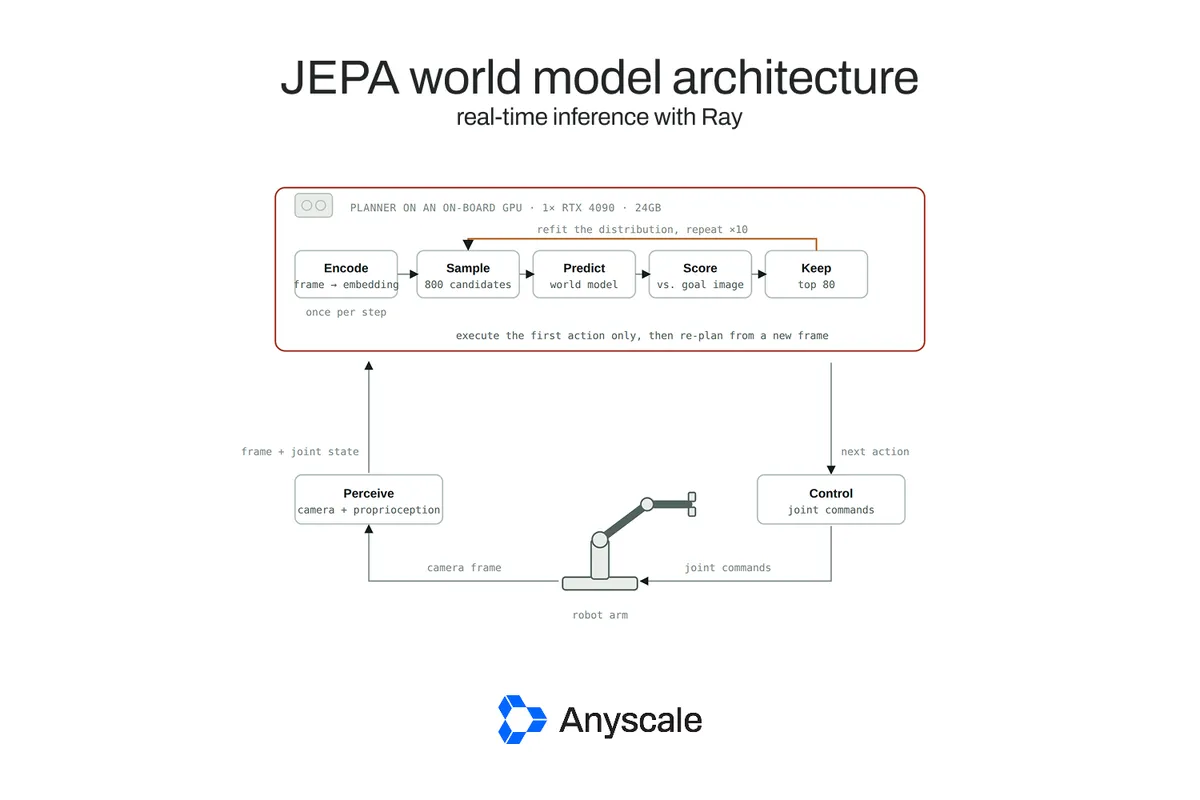
The system ran on a single RTX 4090, but required 16 seconds to plan each action. That delay prevents continuous operation. The robot captures a camera frame, plans, moves, then pauses again while planning the next move. Anyscale says the problem is the repeated search cost rather than the model's accuracy.
Each planning step uses the Cross-Entropy Method, or CEM. It draws 800 candidate action sequences, evaluates them, keeps the best 80, and recenters the search around those candidates. The process runs for ten rounds, producing roughly 8,000 predictor evaluations for one small movement. Only the first action from the winning sequence is executed.
Moving the search from the robot to a cluster
Anyscale's design moves world model inference to a cloud server. The robot continues to handle sensing and actuation, sending one camera frame and its joint state over the network and receiving an action vector in return. The company tested the model on NVIDIA A100-40GB GPUs, which offer more memory than the 24 GB RTX 4090 used in the paper and more bf16 throughput.
A single A100 reduced the measured time to 21.4 seconds per action after model-level optimizations. Anyscale also reports that Meta's reference planner took 81.8 seconds per action on one A100 when run with the released planning code and the stated settings. The company uses that 81.8-second result as its baseline for the speedups in the post.
The larger improvement comes from distributing the independent candidate evaluations within each CEM round. Anyscale ran the search across one eight-GPU node, with eight A100-40GB GPUs, using Ray. This produced a measured 2.86 seconds per action, or 0.86 seconds when using three rounds per step. The ten rounds remain sequential, which limits the minimum time the search can reach.
How Ray organizes the robot inference service
Ray is an open-source framework originally built at UC Berkeley's RISELab and now maintained by Anyscale. Ray Core provides remote functions for distributed tasks and remote classes for stateful actors. Anyscale uses actors to keep the weights of a 1.2-billion-parameter checkpoint loaded between requests.
Ray Serve adds a service layer that manages replicas, routes requests, and scales under load. In the described implementation, two Ray Serve deployments divide the work. WorldModel is the GPU tier, with one replica per GPU holding the encoder and predictor. Planner runs the CEM loop, distributes each round across the model replicas, and exposes the endpoint called by the robot once per control step.
Anyscale says this arrangement places deployment management, health checks, restarts, and configuration under Ray Serve. A declarative KubeRay RayService can roll out the system without downtime, according to the company.
What the results mean for robot control
The implementation changes the planning part of the robot loop while leaving sensing, control, and actuation in place. Its central idea is to parallelize the candidate rollouts that can run independently, rather than processing all of them as one large batch on a single GPU.
The reported 0.86-second result shows that the approach can bring the planning search below one second per action in the tested configuration. It does not remove the network round trip introduced by cloud inference, and the source does not report a complete end-to-end control-loop measurement. The results instead describe a way to make JEPA-based planning more compatible with continuous robot operation by combining Ray Core, Ray Serve, and multiple GPUs.
Anyscale: Real-time inference for JEPA world model architectures with Ray