Apple opens US study on trust and safety in health AI
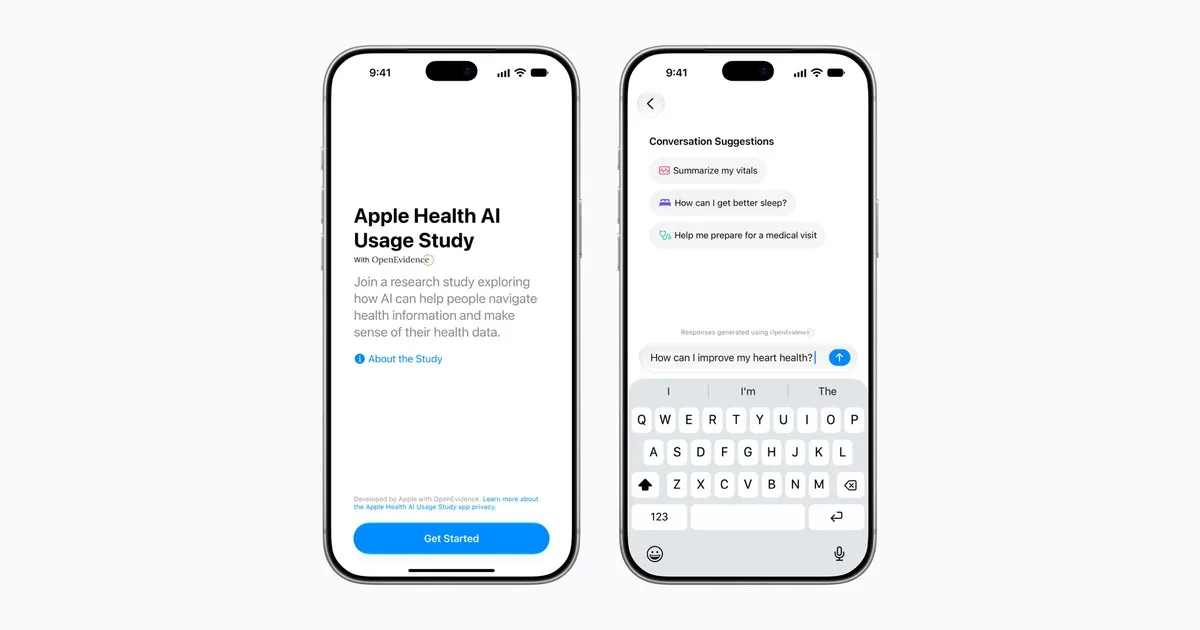
Apple has launched a virtual US research study examining how people interact with conversational health AI tools. The Apple Health AI Usage Study, developed with OpenEvidence, will assess trust, comprehension, response quality and everyday health actions.
- Apple launched the Apple Health AI Usage Study in the United States.
- The study is conducted with clinical AI platform OpenEvidence.
- Participants can ask health questions and view linked clinical citations.
- Study data will not be used to train AI models.
- Up to 200,000 US participants aged 21 and older can join.
Study combines health AI with Apple’s research experience
The study app will let participants ask everyday health questions and explore complex medical information presented in approachable language. Responses will include linked, peer-reviewed clinical citations.
OpenEvidence is providing the medically grounded AI technology for the study. Apple describes OpenEvidence as a clinical AI platform widely used by healthcare professionals, with answers based on medical information from established sources including The New England Journal of Medicine, Journal of the American Medical Association and Nature.
Participants can also choose to share HealthKit data types, including resting heart rate, activity, sleep or lab results. The study will examine whether integrating personal data affects the relevance and understanding of health AI responses.
Apple says the research will guide responsible design
Apple said the study is intended to help it and the wider industry understand what drives user trust, how people assess response quality, and whether they comprehend health information well enough to act on it in everyday life.
Consumer health technologies powered by large language models can sometimes provide incomplete or unclear responses, according to Apple. The company says research is therefore needed to explore how health information can be presented with greater clarity.
The study will also examine whether health AI can help people prepare for appointments with their own doctors. Robert M. Wachter, M.D., UCSF’s professor and chair of the Department of Medicine, said, “When patients and doctors draw on versions of the same trustworthy tools, patients arrive prepared, conversations improve, and next steps happen seamlessly.”
Apple’s Sumbul Desai, M.D., vice president of Health and Fitness, said the company believes “responsible innovation starts with scientific rigor and clinical grounding.”
Privacy controls and clinical safeguards are built into the study
Apple says the study was designed with privacy protections, transparency and clinical guardrails. Study data will not be used to train AI models. Participants retain control over whether to share HealthKit metrics or survey responses, while Apple says it has implemented security measures to protect study data and participant confidentiality.
The app includes safety guardrails intended to detect certain concerning questions and suggest that participants contact a provider or use other resources when needed. Apple also states that the study app is not intended to diagnose or treat any condition, replace medical professionals’ advice, or serve as a substitute for consulting a doctor or clinician.
Who can join the Apple Health AI Usage Study
The study is open to up to 200,000 eligible participants aged 21 and older across the United States. Participants must have an Apple Intelligence-enabled iPhone, specifically an iPhone 15 Pro or later, running iOS 26 or later.
Eligible users can download the study app to learn more and choose whether to enroll. For users, the project offers a way to examine health AI in everyday situations while retaining control over selected data and responses. For Apple and the industry, its findings are intended to inform the design of health AI experiences, although the source does not provide results from the study yet.