ASUS launches Enterprise Agentic AI Solution at NVIDIA GTC Berlin 2026
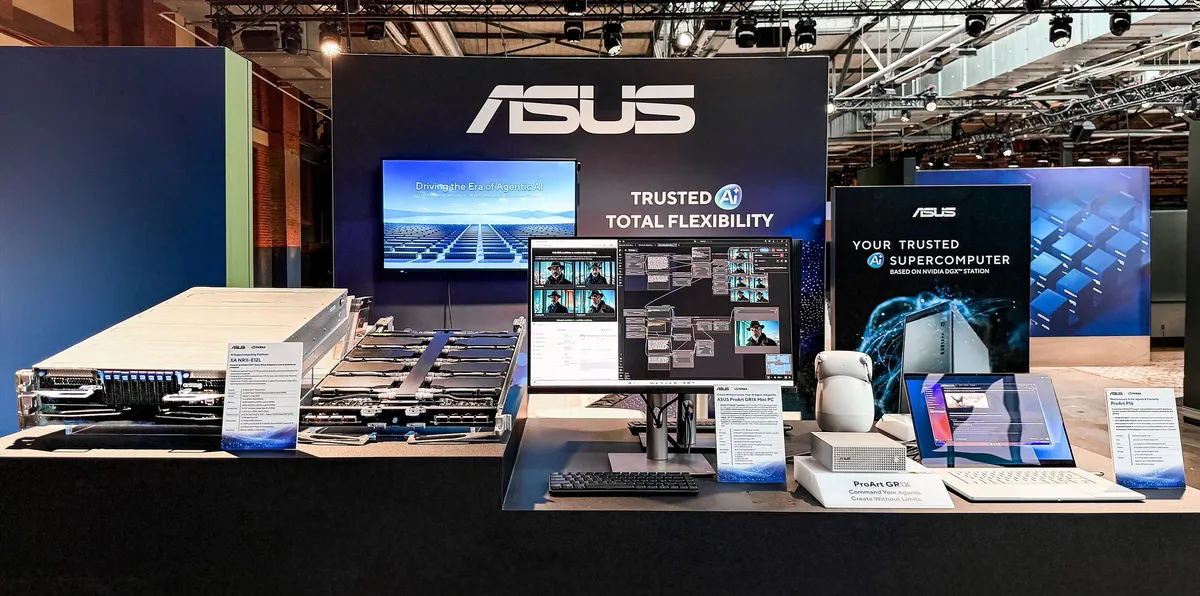
ASUS has unveiled its Enterprise Agentic AI Solution, an integrated offering of infrastructure, software and services meant to help companies deploy, govern and scale agentic AI from development to production. The company is showing the solution at NVIDIA GTC Berlin 2026 together with a wide hardware lineup, from data center racks to desktop agent computers.
- ASUS unveiled its Enterprise Agentic AI Solution at NVIDIA GTC Berlin 2026, combining ASUS AI HUB, NVIDIA AI Enterprise with the ASUS AI Software Stack, and AI servers.
- ASUS says its AI factory platform with NVIDIA Vera Rubin NVL72 is co-designed for 30X-higher throughput per megawatt and 45X-lower token cost.
- The Ascent GX10 is now available with 64GB and 128GB of unified memory and supports models of up to 200 billion parameters.
- ASUS server products are available worldwide, and no pricing was given.
Three layers for running agentic AI at scale
According to ASUS, the Enterprise Agentic AI Solution combines three core layers. The first is ASUS AI HUB, which handles fleet-wide agent registration, governance and monitoring. The second is NVIDIA AI Enterprise together with the ASUS AI Software Stack, covering orchestration and workflow integration. The third is ASUS AI servers and infrastructure.
As an example of the infrastructure layer, ASUS names its full-stack AI factory platform powered by NVIDIA Vera Rubin NVL72. The company says this platform is co-designed to deliver 30X-higher throughput per megawatt and 45X-lower token cost for agentic AI.
ASUS says customers in finance, healthcare, manufacturing, the public sector and other regulated industries can use a streamlined configuration process, based on model scale, performance targets and operational requirements, to identify and deploy a suitable platform.
Servers and edge systems
On the enterprise side, ASUS is showing NVIDIA MGX servers built for agentic AI workloads:
- XA P2N-E2: a 2U AI server powered by NVIDIA Vera CPUs.
- XA P8A-E14AXL: a high-density 6U system supporting eight liquid-cooled NVIDIA RTX PRO 6000 Blackwell Server Edition GPUs.
- ESC8000-E12P: supports NVIDIA RTX PRO 4500 Blackwell Server Edition GPUs for AI, data processing and visual computing.
- ESC8000A-E13X: combines NVIDIA RTX PRO 6000 Blackwell GPUs with NVIDIA ConnectX-8 SuperNICs for high-speed GPU-to-GPU connectivity.
For physical AI, ASUS presents the PE3000N, powered by the NVIDIA Jetson T5000 module built on NVIDIA Jetson Thor. It delivers up to 2,070 FP4 TFLOPS of AI performance and 128GB of memory, according to the company. The PE6000G serves as a workstation-grade AI and simulation platform for industrial environments. ASUS positions both for robotics, autonomous machines and intelligent video analytics.
Agent computers for the desk
ASUS also extends the portfolio to desktops and laptops. The ExpertCenter Pro ET900N G3 is built on the NVIDIA GB300 Grace Blackwell Ultra Desktop Superchip with 748GB of coherent memory. ASUS says it lets businesses develop, train and deploy large language models and generative AI on-premises while keeping full control over their data.
The Ascent GX10, based on the NVIDIA DGX Spark platform, is now available with both 64GB and 128GB of unified memory. ASUS says it supports models from roughly 30-35 billion parameters up to 200 billion parameters, and up to four systems can be clustered using NVIDIA Sync Cluster Assistant.
The ProArt P16 and P14 laptops, powered by NVIDIA RTX Spark, offer up to 1 petaflop of AI performance and up to 128GB of unified memory, according to ASUS. The P16 measures 12.9mm and weighs 1.77kg, which ASUS calls the thinnest 16-inch ProArt laptop to date. The P14 is 13.9mm thick and weighs 1.48kg. Battery capacity reaches up to 99.9Wh for the P16 and 90Wh for the P14. ASUS has also partnered with Hermes Agent and ComfyUI for local-first, cloud-flexible creative and development tools.
The ProArt GR1X mini PC fits into a 150x150x51mm chassis and is designed for 24/7 operation. ASUS says it allows autonomous agents to run complex 3D rendering and creative workflows in the background overnight.
Availability and what it means
ASUS is exhibiting at Booth #3039 at Station Berlin during GTC Berlin 2026, and its VIP Room at the W3 Hub is open October 20-22. The company states that its server products are available worldwide and directs customers to local ASUS representatives for details. The release gives no pricing.
For enterprises, the announcement shows ASUS packaging governance software, orchestration and hardware into a single offer, aimed especially at regulated industries. Buyers can also see how the company spreads the same NVIDIA-based approach across data center, edge, workstation and PC tiers.