AWS Says Agents Wrote Its 200+ Service Emulator Without Human Code Review
AWS says autonomous agents wrote and tested every line of AWS Emulator, a free local copy of more than 200 AWS services, while a merge gate controlled which changes reached the codebase. The claim shifts attention from line-by-line review to the rules, tests and security checks engineers use to govern agent-written code.
- AWS says agents wrote and tested all of AWS Emulator’s code.
- The emulator covers more than 400 API models and more than 200 AWS services.
- A merge gate checks builds, coding standards, security and fidelity regressions.
- AWS says its team did not write or review the emulator’s code.
- The emulator does not reproduce IAM policy evaluation, cross-account or cross-Region behavior.
Agents built the emulator from AWS specifications
AWS Emulator is generally available from 11 November 2026 with “no additional service fee”, according to AWS. It covers more than 400 public API models representing more than 200 AWS services. AWS designed it as a local test environment for applications that depend on AWS APIs.
The project began with a proposal from Matt Goldberg, a Senior Principal Engineer on the AWS Developer Tools team. Coding agent Kiro was given a three-step task: write tests from the AWS CLI, make those tests pass against real AWS, and then build an in-memory implementation that passed the same tests. Goldberg writes that Kiro produced a passable Amazon SQS emulator in about 15 minutes and a rough version of the rest of AWS by Monday.
AWS had two important inputs for this process. Its public API models, written in the Smithy format, describe the services, while the AWS cloud provides a live answer key against which tests can be checked. The project eventually used tens of thousands of fidelity tests and hundreds of agents fixing thousands of issues a day, according to AWS.
A merge gate replaced line-by-line human review
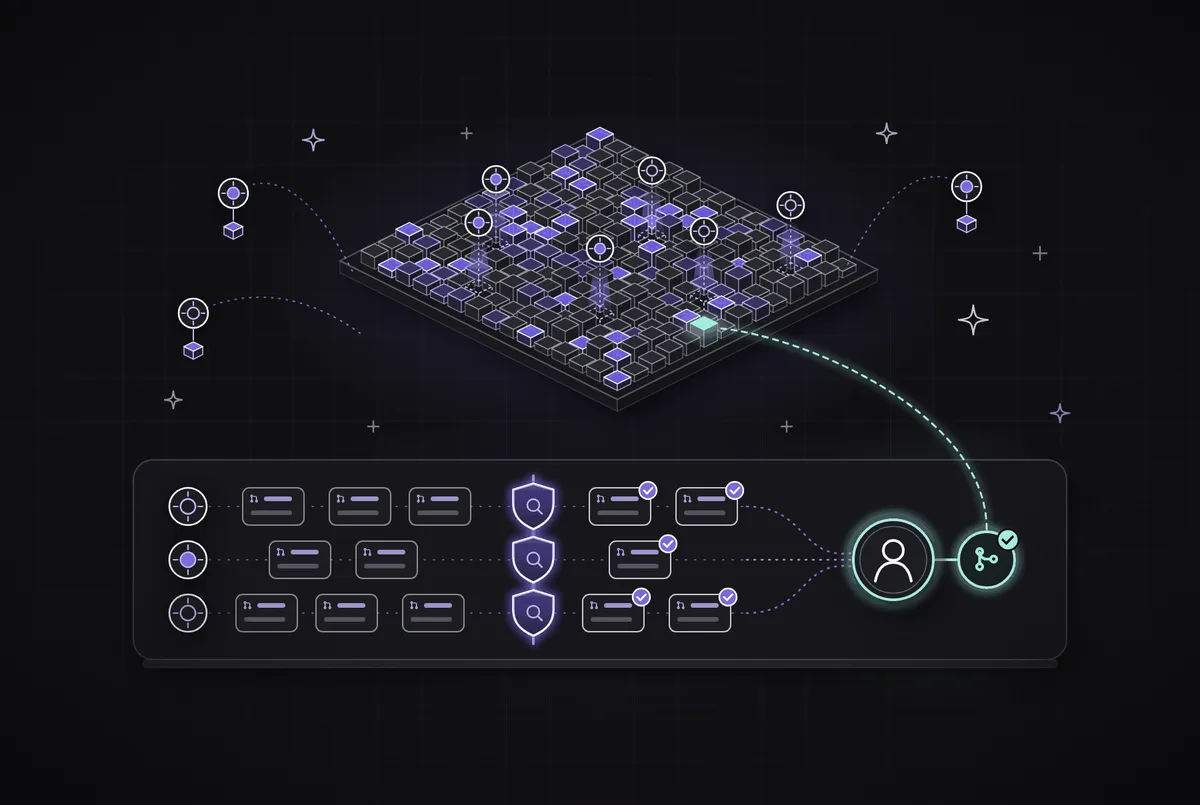
AWS says three groups of agents handled the main development loop. One created fidelity tests based on real customer scenarios, such as creating a queue and sending a message, and verified them against AWS. A second replayed those tests against the emulator and filed failures, grouping issues with a shared root cause. A third assigned one issue to each agent and edited the code until the problem was fixed.
Every fix then went through a merge gate. The gate checked whether the change compiled, reviewed coding standards, tested for security problems and checked for fidelity regressions. Changes that failed were sent back for rework, while those that passed all checks were merged. An independent security agent also reviewed changes adversarially during the fix and again in the release pipeline, according to the AWS News Blog.
“The emulator was written entirely by autonomous agents. Our team hasn’t written or reviewed any of the code,” Goldberg said in AWS’s launch post on 11 November 2026. He also said, “Without this merge gate, we wouldn’t trust what our agents are building.”
The approach depends on unusually strong test inputs
AWS’s example does not mean that agents can safely replace human review in every codebase. The emulator had a machine-readable specification for each operation and a live system that could verify the expected behavior. Most products and internal systems do not have both.
The source identifies several problems teams face when those inputs are missing. Coding rules may remain in people’s heads, while the intended behavior of a change may be unclear beyond the ticket. Security findings can also appear alongside ordinary review comments instead of receiving a separate adversarial check. In a 2026 survey of 500 US developers and 300 US engineering leaders cited by Qodo, reviewing and validating AI-generated code was the main delivery constraint for 25.8% of developers and 26.0% of engineering leaders. Another 36.4% of developers said AI-generated code took the same review time while requiring more mental effort.
The source says AWS’s model moves the engineer’s role toward defining rules, specifying what correct means and deciding which findings require a person. Qodo describes a similar workflow for everyday pull requests, checking them against REVIEW.md, organization instructions and linked tickets, while labeling security findings by severity and recording what was resolved.
AWS Emulator still has documented limitations
AWS’s own documentation marks important boundaries. Unsupported operations return HTTP 501, the emulator does not evaluate IAM policies in the same way as AWS, and it supports one account rather than cross-account or cross-Region behavior. AWS tells users not to use the emulator to test security because a request that AWS would deny might succeed locally.
The repository keeps issues filed by the agents, with open gaps under issues/things-that-do-not-work/ and fixed issues under issues/things-that-now-work/. Its public main branch had about 29,700 commits when read on 12 November 2026, with recent commits attributed to agents named IssueFinderAgent and IssueFixerAgent. AWS’s project demonstrates how a large, well-specified system can be built with agents and a strict gate, but it also shows that the gate depends on tests and specifications strong enough to define correct behavior.