Clivet Unveils Dual-Shaft Magnetic-Bearing Compressor for GW-Scale AI Data Centers
Clivet, a brand of Midea, unveiled a next-generation magnetic-bearing centrifugal compressor and a full-chain liquid cooling solution at the 2026 OCP Global Summit in San Jose. According to the company, the design cuts compressor power by up to 40% at the same cooling capacity.
- Midea's brand Clivet unveiled a dual-shaft magnetic-bearing centrifugal compressor at the 2026 OCP Global Summit.
- Each impeller has its own variable-frequency drive, and the second stage can shut down at low pressure ratios.
- According to Clivet, compressor power falls by up to 40% at the same cooling capacity, and maximum inlet flow at low pressure ratios rises by approximately 70%.
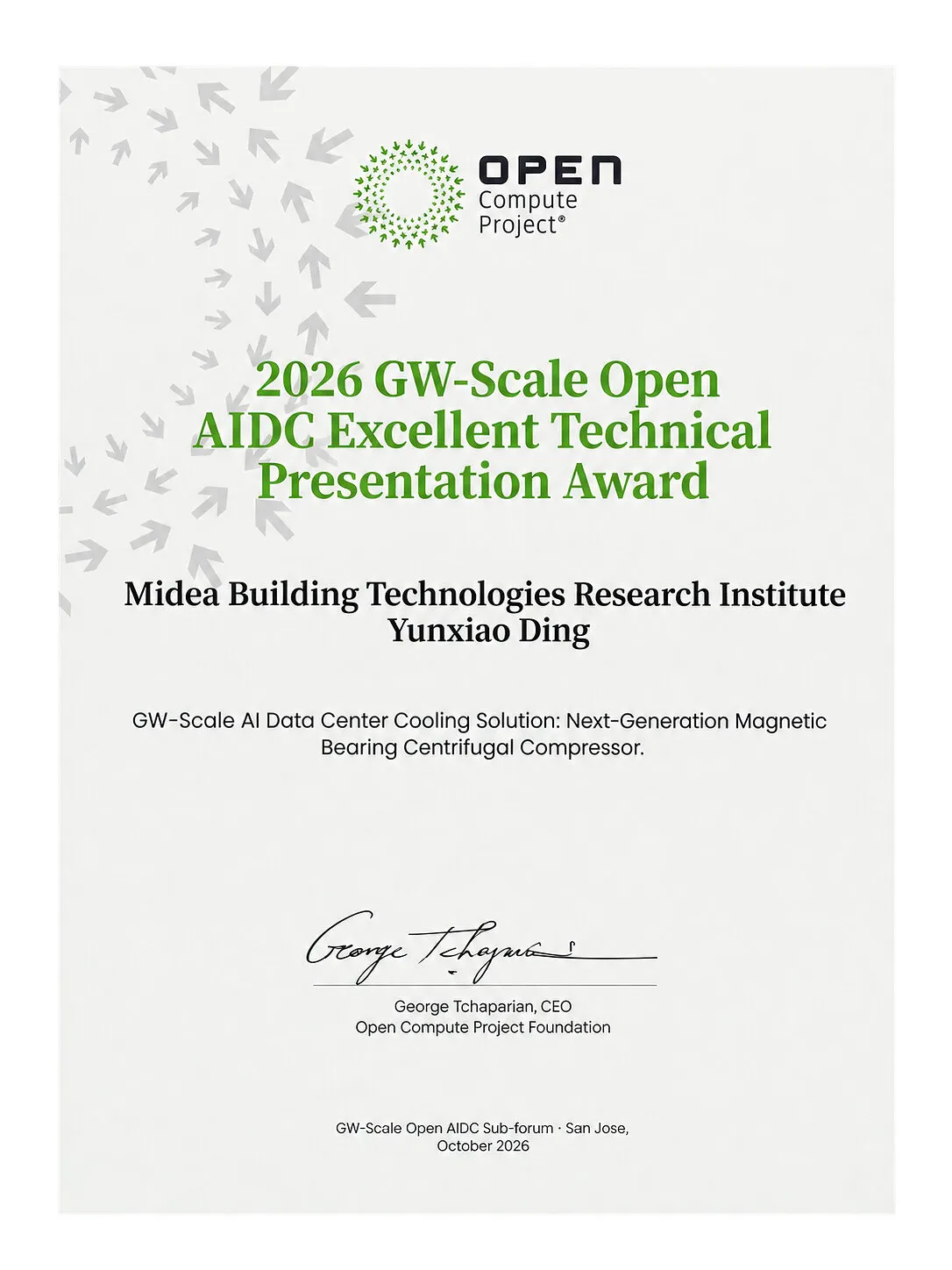
- Clivet won the "2026 GW-Scale Open AIDC Excellent Technical Presentation Award".
- Midea appeared on the NVIDIA MGX ecosystem's participating company list.
What Clivet presented at OCP
Clivet took the stage at the "GW-Scale Open AIDC" forum during the 2026 OCP Global Summit. Dr. Yunxiao Ding, Director of the Research Institute at Midea Building Technologies, gave a presentation on architectural innovation for cooling next-generation AI data centers.
According to the company, Clivet received the "2026 GW-Scale Open AIDC Excellent Technical Presentation Award" for its work on a magnetic cooling source and cooling-continuity architecture. Midea also appeared on the participating company list of the NVIDIA MGX ecosystem at this year's summit.
Three cooling challenges the design targets
The company says cooling systems are changing as AI data centers move toward GW-scale. As cold-plate supply temperatures rise toward 45°C, there are more opportunities for free cooling, while water constraints favor dry heat rejection. Operators who prioritize free cooling but keep mechanical cooling as a backup face three technical problems, according to Clivet:
- Wide-range efficiency: traditional compressors struggle to deliver high cooling capacity in hot weather and high efficiency at low pressure ratios in mild weather.
- Smooth two-way transitions: when switching between free cooling and mechanical cooling, rapid pressure changes can cause cooling fluctuations or even interruption.
- Compact integration: equipment must deliver higher cooling performance in minimal space while leaving enough room for heat exchange and maintenance.
How the compressor works
Clivet's compressor combines independent dual-shaft variable-speed drives with selectable single- and two-stage operation. It departs from the traditional single-shaft, same-speed dual-stage structure: each impeller has its own variable-frequency drive. At high pressure ratios, both shafts work together at different speeds for high-efficiency compression. At low pressure ratios, the second stage shuts down automatically and is bypassed, so the unit runs in single-stage mode. The company says this breaks through flow limits and removes extra power consumption.
Clivet reports that, at the same cooling capacity, compressor power is reduced by up to 40%, and maximum inlet flow at low pressure ratios increases by approximately 70%.
Single-stage startup and preconditioning are meant to smooth mode changes. When moving from free cooling to mechanical cooling, the single-stage path rapidly builds system flow and cooling capacity, which the company says significantly shortens cooling recovery time after power interruptions. In the reverse direction, single-stage preconditioning smooths system fluctuations and, according to Clivet, eliminates cooling interruptions during transitions.
On size, the company says outboard bearings are nested into the volute recesses, multifunctional components are integrated and compact motors are used. The dual-shaft unit therefore keeps the same axial dimensions as a traditional single-shaft one, leaving space inside for heat exchange and maintenance.
What it means for AI data center cooling
Clivet frames the design as a change in how the compressor works within a system that puts free cooling first, rather than the refinement of a single component. It says the result is a wider efficient operating range, smoother cooling-mode transitions and more compact integration.
Midea, the parent brand of Clivet, says it will keep building on self-developed core technologies and its "equipment + systems + ecosystem" layout, and will work with global industry partners. The company presents this as a practical, green and cost-reducing path for high-density AI data centers. The figures cited are Clivet's own claims, and the announcement does not give pricing or availability.