CodeRabbit finds 1,215 security issues across open-source repositories
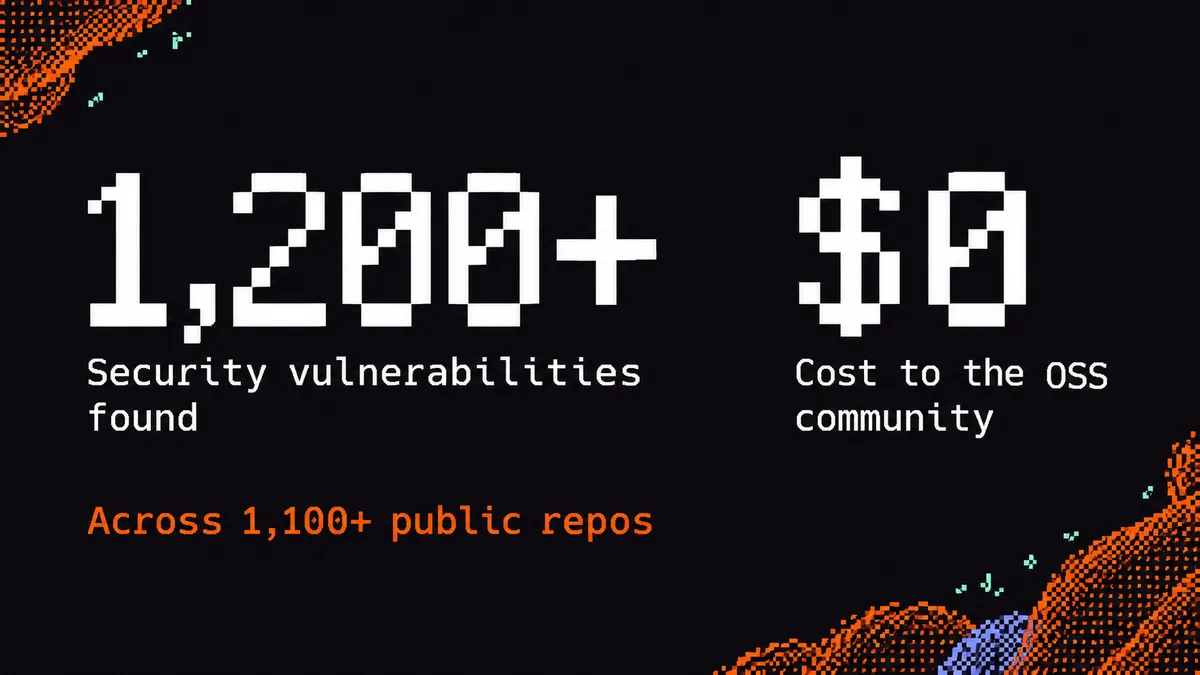
CodeRabbit says its Secure Deep Scans identified 1,215 high or critical security findings across 1,125 public repositories, and that at least 75 have been fixed. The company is offering qualifying open-source projects one free Deep Scan as it continues its security campaign.
- Deep Scans identified 1,215 high or critical findings in 1,125 public repositories.
- The findings included 1,200 high-severity and 15 critical issues.
- At least 75 findings have been fixed.
- Qualifying projects can receive one free first Deep Scan, worth up to $1,000.
- CodeRabbit’s Fix with AI can prepare patches and open pull requests for review.
Deep Scans uncovered more than 1,200 findings
CodeRabbit conducted the scans between October 23 and November 3. The findings included 1,200 high-severity issues and 15 critical issues, with at least 75 fixed so far.
The company said the most common problems included missing ownership checks, unsafe handling of browser scripts, weak identity verification, unsafe file paths, incomplete session expiry checks and information exposure. These issues can arise when security controls are distributed across routes, services, database queries or other parts of an application.
Herrington Darkholme, creator of ast-grep, said in the company’s announcement: “I tried Deep Scan against ast-grep and was impressed by its precision. Proving vulnerabilities before flagging them makes every finding much more actionable.”
The tool follows code paths and verifies its findings
CodeRabbit says Secure Deep Scan examines committed code and infrastructure configuration across an open-source repository, including legacy code. Its workflow maps security-relevant entry points, trust boundaries, access controls, sensitive operations and configuration before investigating suspected vulnerabilities across connected code paths.
A separate verifier then reopens the cited source, checks whether the reported path is reachable and looks for existing safeguards that could prevent exploitation. Findings include severity, supporting code and reasoning, allowing maintainers to inspect the evidence behind the result.
For supported findings, the Fix with AI feature sends the issue to CodeRabbit Agent, which prepares a proposed patch and opens a pull request for review. Maintainers can follow the task, request changes and review the diff. They can also share the finding and recommendation as self-contained Markdown with another coding agent.
CodeRabbit describes Deep Scan as a complement to rule-based static analysis and dependency scanning. Incremental delta scans can revisit changed files and areas that remain stale or unverified after an initial full scan.
Open-source projects can claim one free scan
CodeRabbit linked the need for deeper checks to attacks in which AI agents can try multiple paths, adapt when attempts fail and complete parts of an intrusion in minutes or seconds. The company also cited recent security incidents involving PHP, LiteLLM and a Brotli memory bug patched by Node.js, Bun and .NET.
CodeRabbit said its $1 million free Deep Scan promotion has ended, but its commitment of more than $10 million to open source continues. Open-source projects trying Deep Scan for the first time can receive one free scan, covering up to $1,000. To qualify, a project must have two or more members.
For maintainers, the offer provides access to a scan that combines vulnerability investigation, evidence checking and, for supported findings, a proposed fix. CodeRabbit says traditional static analysis and dependency scanning should remain part of the security workflow, positioning Secure Deep Scan as an additional way to investigate application-specific flaws.