d-Matrix Opens Demo Cloud for Corsair Inference Evaluations
d-Matrix has made its hosted Demo Cloud available to selected customers, partners and evaluators, offering a way to test Corsair-powered inference on production-grade models within minutes. The service provides OpenAI-compatible access to real Corsair hardware and GPU-backed heterogeneous inference endpoints, subject to capacity.
- d-Matrix Demo Cloud is now available to selected evaluators.
- Users can test Corsair-powered inference through an OpenAI-compatible gateway.
- Speculative decoding is available today, with AFD and Corsair endpoints coming soon.
- The company reports 476.4 tokens per second per user for one SpecDec configuration.
- Access is gated and capacity is limited.
A self-service gateway for inference testing
The d-Matrix Demo Cloud gives evaluators a pre-provisioned workspace with a dashboard showing deployed endpoints, active API keys and a base URL. Users can generate scoped inference API keys and authenticate with a standard Bearer token, using the same pattern as OpenAI’s SDK.
The hosted models use the OpenAI wire protocol, so existing clients can be redirected to d-Matrix through configuration changes rather than a rewrite. The company says the service supports chat completions, the Responses API and agentic coding tools such as Codex CLI. Its examples include running coding tasks against a hosted model such as Qwen3 235B.
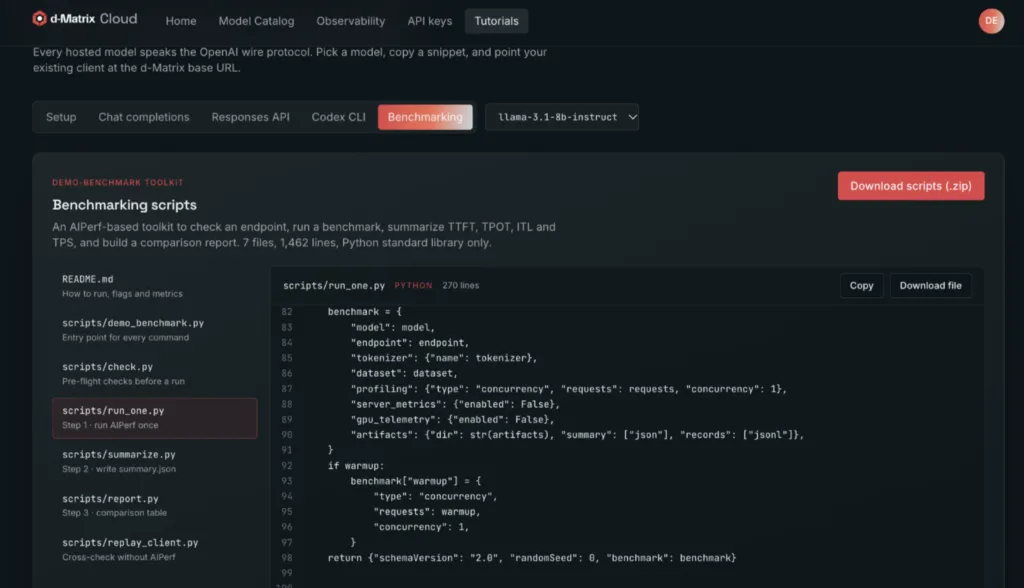
A Tutorials tab includes copy-ready examples for the Responses API, Codex CLI and AIPerf. AIPerf can be used to measure time to first token, inter-token latency and per-user throughput, according to d-Matrix.
Corsair and GPU resources share the workload
One endpoint available today is speculative decoding, or SpecDec. In this configuration, a discrete draft model on Corsair proposes tokens and a larger target model on a GPU verifies them. d-Matrix says the approach lets the GPU handle a more parallelized workload while using Corsair for the draft step.
The Demo Cloud also provides pre-vetted deployment configurations covering different deployment modes, compute and memory allocations, and compatibility with chat completions and the Responses API. A model catalog example shows a Qwen3.5-27B target model on 1 H200 GPU with a small draft model on 2 Corsair cards.
d-Matrix reports that a configuration using Qwen3-1.7B as the draft model and Qwen 235B as the target model can achieve 476.4 tokens per second per user. This is the company’s stated result for that configuration.
A path from evaluation to deployment
The service uses a single inference gateway in front of a Kubernetes-based serving fleet built on d-Matrix Squadron. The gateway handles API keys, users and organizations, model routing, and telemetry including throughput, time to first token, inter-token latency and tokens per second per user.
A Kubernetes deployment operator converts routing and deployment intent into running endpoints, while a provisioning plane manages endpoint lifecycles, node pools and the model registry. d-Matrix says this separation allows models to be added, moved or scaled without client-side changes.
Heterogeneous attention-FFN disaggregation endpoints and Corsair endpoints are listed as coming soon. The company says AFD separates attention and feed-forward stages across hardware suited to each task, while Corsair endpoints will serve whole models directly on dedicated node pools made up of Corsair, JetStream and NVIDIA hardware.
The Demo Cloud incorporates technology from Wallaroo.ai, whose AI inference deployment and orchestration software and engineering team joined d-Matrix in August. d-Matrix says the service is intended for enterprises, neoclouds, inference platforms and partners comparing heterogeneous compute with existing infrastructure. Access is gated through the d-Matrix team, and capacity is limited, with dedicated Corsair and GPU allocations provided to evaluators.