Databricks Opens Genie ZeroOps to Public Beta for Pipeline Fixes
Databricks has moved Genie ZeroOps into public beta, giving workspace teams an autonomous agent that detects, investigates and helps resolve data pipeline issues. The company says the system was refined through observations from more than 80,000 customer pipeline issues.
- Genie ZeroOps is now available in public beta.
- Databricks says it observed more than 80,000 customer pipeline issues.
- The agent detects, investigates, verifies and proposes fixes for pipeline problems.
- Teams can use shared inboxes, custom instructions and one-click pull requests.
- ZeroOps requires human approval before production code or data changes.
An agent for the full pipeline incident workflow
Genie ZeroOps is designed to handle the work that usually follows a pipeline problem, from an initial alert through a proposed code fix. Databricks says it can identify hard job failures as well as silent problems, including tables that stop updating or data loads that arrive with fewer rows than expected.
The agent works through five steps. It detects issues in jobs, pipelines and tables, investigates logs, source code, table metadata and lineage, verifies possible fixes with unit tests and sandbox dry runs, sends notifications, and proposes remediation. For Git-backed Jobs, it can automatically create a pull request with details pre-populated.
Notifications can be sent to Slack, Teams or PagerDuty. ZeroOps can also filter lower-priority issues, helping teams focus on incidents that require attention.
Features shaped by 80,000 customer issues
During its private preview, Databricks says Genie ZeroOps observed more than 80,000 real customer issues across hundreds of companies. The company found that over half of those issues required organization-specific knowledge to triage, rank or resolve properly.
In response, the public beta adds a shared inbox so teams can see the same incidents, along with notifications that include a summary of each issue and recommendation. Teams can also add custom agent instructions covering details such as known flaky sources, preferred fixes and naming conventions.
A one-click pull request feature moves users from diagnosis to a proposed code change. Databricks also says ZeroOps follows existing Unity Catalog permissions, while personally identifiable information is redacted before a notification leaves Databricks.
Human approval remains required
Genie ZeroOps does not directly change production code or data. According to Databricks, it investigates failures, proposes a fix and can push that fix to a new branch for a pull request, but a person must review it before any production change.
The agent reads run logs, source code, upstream table metadata and samples while respecting Unity Catalog permissions. Databricks says its models are hosted inside the company's security perimeter, model calls stay in the workspace's region, and the model provider does not retain prompts or responses.
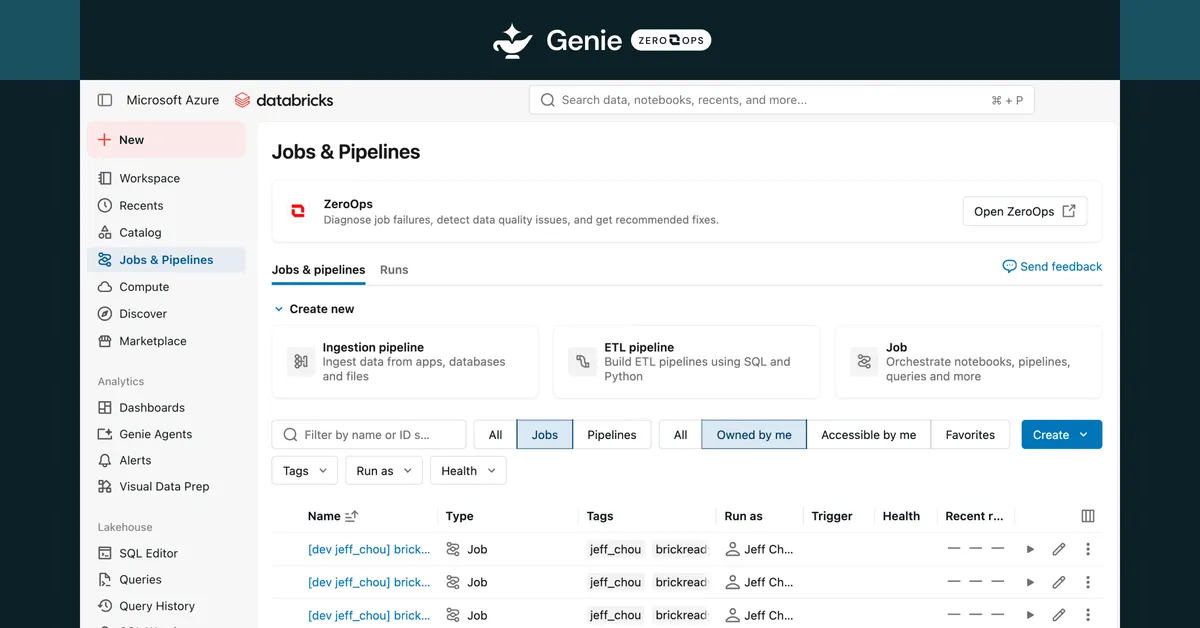
A workspace admin can enable the public beta from the workspace Previews page. After activation, users can find the ZeroOps banner at the top of the pipelines page. The release gives data teams a way to automate investigation and recommendation while retaining review and governance controls.