Databricks says Lakehouse//RT cuts the cost of real-time analytics
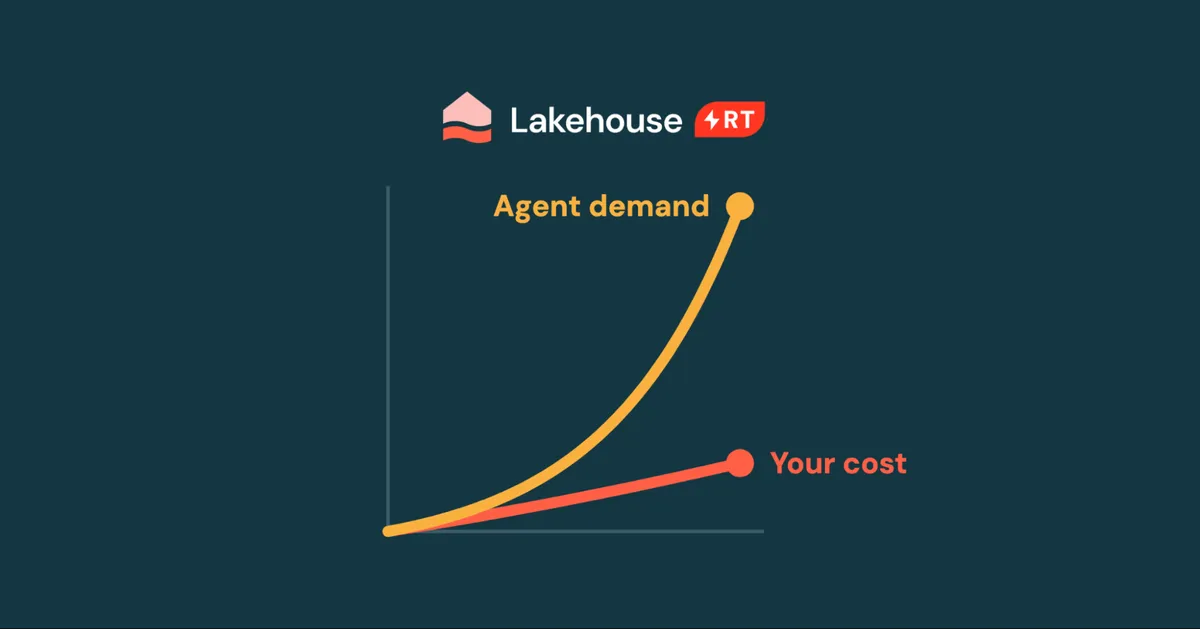
Databricks says Lakehouse//RT is designed to absorb the rising query volumes generated by AI agents without a proportional increase in infrastructure spending. Customers using the platform instead of separate real-time serving layers report infrastructure costs that are 6x to 10x lower, according to the company.
- Lakehouse//RT is designed for high-volume real-time queries from AI agents and users.
- Databricks says customers report 6x to 10x lower infrastructure costs.
- The platform supports high concurrency and autoscaling in small increments.
- Aurasell reported more than 250 QPS and 10x lower costs.
- nOps eliminated 40TB of duplicated data after migrating from Apache Druid.
AI agents are changing the cost equation
Databricks says a human analyst may run a few dozen queries in an afternoon, while an AI agent can run hundreds per second around the clock. Customer-facing dashboards that refresh in milliseconds and applications with embedded analytics are also increasing demand for real-time workloads.
The company argues that many data warehouses were designed for human-scale query volumes rather than sustained concurrency from agents and thousands of users. In that model, a tenfold increase in queries can potentially lead to a tenfold increase in cost. Spiky demand can also force teams to overprovision capacity, leaving compute idle outside peak periods.
Lakehouse//RT is intended to serve real-time workloads directly on the lakehouse while avoiding that proportional cost growth. Databricks says its approach combines higher concurrency, faster execution, autoscaling in small increments and a single system instead of separate serving infrastructure.
More queries on the same resources
According to Databricks, Lakehouse//RT can run more queries side by side on each warehouse, allowing capacity to serve more requests before additional resources are needed. The company says its launch blog reported sub-100 millisecond latency at 12,000 queries per second.
The platform also aims to reduce the time each query holds compute, including the time needed for planning, routing and returning results. Databricks says it can add capacity in small steps, including one node at a time, rather than requiring a full additional cluster when traffic rises by only a fraction of the existing capacity.
The company also positions Lakehouse//RT as an alternative to separate real-time layers such as Apache Druid, Apache Pinot or a cache. Those architectures can require always-on infrastructure, copied data, synchronization pipelines and additional engineering work. Lakehouse//RT queries governed lakehouse data directly, Databricks says.
Customers report lower costs and simpler architectures
Aurasell moved from several clusters handling 200 queries per second to one small Lakehouse//RT warehouse sustaining more than 250 QPS. Databricks says queries ran 4-5x faster and infrastructure and costs fell by 10x. Aurasell CTO Srinivas Bandi said the company gained real-time performance in Databricks without moving or indexing data into external systems.
VisionHeight switched from Apache Pinot and always-on EC2 clusters to Lakehouse//RT's serverless model. The company reported a cost reduction of more than 90%, while its heaviest query achieved sub-second response times, nearly 3x faster than Pinot. Databricks says the migration took three days.
nOps replaced an Apache Druid layer that required a separate always-on cluster and 40TB of duplicated data. After the migration, the company reported infrastructure costs more than 6x lower and eliminated the duplicated data. Databricks says nOps moved without data copying, new ingestion pipelines or new infrastructure.
These examples support Databricks' central claim that real-time systems need to improve efficiency per unit of compute as AI-driven query demand grows. For teams already maintaining separate serving layers, the company presents Lakehouse//RT as a way to consolidate infrastructure while querying data where it lives.
Databricks: Lakehouse//RT: Scale real-time analytics, not your bill