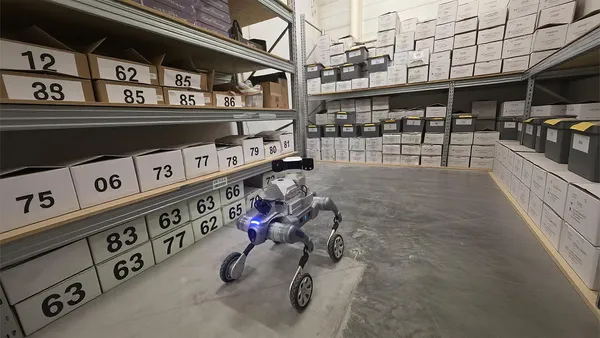
Penn's GRASP Lab and Singapore's DSTA Start Five-Year Multi-Robot Research Deal
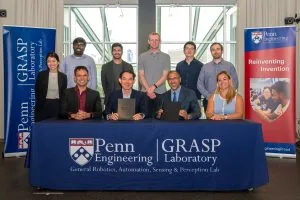
The University of Pennsylvania's GRASP Laboratory and Singapore's Defence Science and Technology Agency (DSTA) have signed a Master Research Agreement, starting a five-year collaboration on software that lets distributed teams of robots communicate and coordinate more effectively.
- Penn's GRASP Laboratory and Singapore's DSTA signed a Master Research Agreement.
- The agreement starts a five-year collaboration.
- The work targets software for distributed robot teams to communicate and coordinate more effectively.
- CJ Taylor, GRASP Faculty Director, said the goal is to make multi-robot systems more capable and easier for humans to interact with and program.
- The signing took place at GRASP's PERCH lab at Pennovation Works.
A signing at Pennovation Works
GRASP, short for General Robotics, Automation, Sensing, and Perception, hosted a team of DSTA executives to mark the signing. The event took place at GRASP's PERCH lab at Pennovation Works, according to Penn Engineering.
The agreement marks the beginning of a five-year partnership between the two organizations. Its stated focus is the development of software systems that would allow distributed teams of robots to communicate and coordinate more effectively.
Focus on multi-robot systems
After the signing, GRASP Faculty Director CJ Taylor led the DSTA delegation through presentations of new developments at the laboratory. Taylor said he is looking forward to expanding the reach of GRASP's research through the collaboration.
He described the research goals in broad terms. "We are interested in advancing the state of the art, particularly in multi-robot systems. These are systems that can be deployed in various human machine teaming contexts," Taylor said, according to Penn Engineering. He added: "We want to make these systems more capable and easier for humans to interact with and program."
Two aims stand out in his remarks: making multi-robot systems more capable, and making them easier for people to interact with and program.
What the agreement means
The announcement gives few details beyond the framework. It does not list specific projects, funding, deliverables or deployment plans, and it does not say when any results might be published or used.
What it does establish is a long-term, formal research relationship between a leading university robotics lab and a Singapore defence technology agency, centered on coordination software for robot teams. The five-year term suggests the work is intended as sustained research rather than a single project, and the emphasis on human machine teaming points to systems designed to work alongside people.