Harvey Builds Ethical Wall Controls Into Documents, Search and AI Work
Harvey is building ethical wall enforcement into its platform so law firms can apply matter restrictions to documents, search results and AI-generated work. The company says its system checks both resource permissions and a user’s clearance for each linked Client Matter.
- Harvey is linking documents, conversations, tables and drafts to Client Matters and their walls.
- Matter imports and wall-policy updates run as separate sync jobs.
- The system retains existing restrictions when policy fetches or user matching fail.
- Search checks wall policies before returning Client Matter results.
- Harvey says its largest workspace has about 1.7 million matters.
Bringing law firm restrictions into Harvey
Law firms use ethical walls, also called information barriers, to limit access to confidential matter information. An inclusionary wall allows access only to people on its list, while an exclusionary wall blocks listed people and allows everyone else.
Harvey says firms manage matter records and wall policies in their own systems, which the platform imports. A document management system can enforce restrictions on the documents it stores, but Harvey also creates conversations, tables and drafts from those documents. The company says those resources need the same protection, even when someone shares the resulting work with another colleague.
To apply the restrictions across its products, Harvey links Vault projects and files, conversations and Review Tables to Client Matters and their walls. The company says one policy engine handles wall questions across the platform, while each resource type determines how the relevant matter links affect access.
Separate imports keep matter and wall data current
Harvey’s import architecture separates matter identity from access policy. Provider adapters translate information from each wall provider into a common model, while each firm’s data remains in its own private Harvey workspace.
The system uses two sync jobs. Client Matter sync finds matters in an external system and links them to existing Harvey Client Matters or creates new ones. When walls are enabled, it can also establish a matter’s wall. Wall sync refreshes policies for matters already linked to the external system, matches people to Harvey users and updates whether a matter is open or walled.
According to Harvey, keeping the jobs separate allows firms to schedule them independently, prevents a failure in one from blocking the other and lets firms adopt matter imports without enabling walls. Both jobs can run on a recurring schedule, as a one-time bulk run or for a single matter. Harvey says its workflows use Temporal for retries, resumable batches and visibility into partial failures.
The system is designed to fail closed. If Harvey cannot fetch a policy, it retains the last stored policy. If it cannot match someone on an exclusionary wall, it keeps that person on the block list. If it cannot match someone on an inclusionary wall, that person remains off the access list.
Wall-aware search and access checks
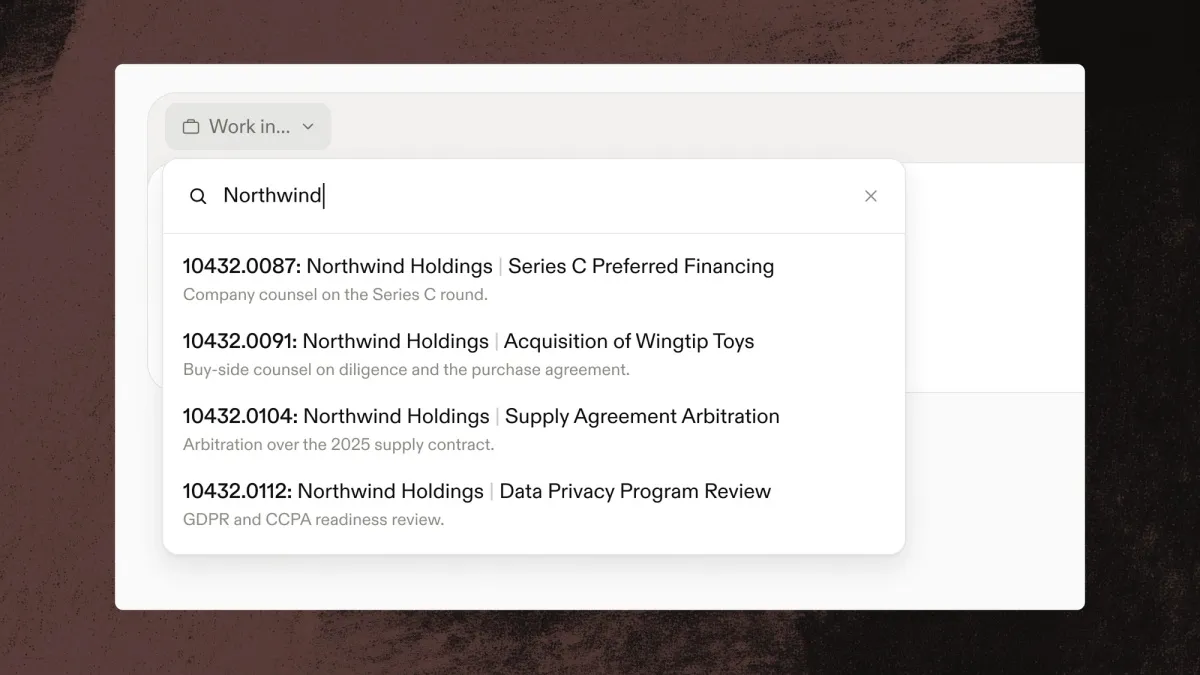
The Client Matter picker is where users select a matter for a conversation, Vault project, Review Table or Space. Harvey says its largest workspace has about 1.7 million matters, making search speed and flexibility important. Users can search by matter code, client name, matter name, description or Space name.
The company is moving the picker to a dedicated search index built on turbopuffer. Each workspace has its own index, with one entry per matter. The database remains the source of truth, and Harvey says the picker falls back to the database if the index is slow or unavailable.
Harvey uses the index to find matching matters, then checks the wall policy stored in the database before showing results. The index contains searchable text rather than wall data, so a delayed index update does not determine access. Users without wall-management access do not see walled matters they are not cleared to access, while wall administrators can see matters for management without automatically gaining access to their work.
The approach is intended to carry a firm’s existing information barriers into AI-assisted work, reducing the risk that a document restriction stops applying when information is used in another Harvey resource.
Harvey: Building Ethical Wall Enforcement Into Harvey