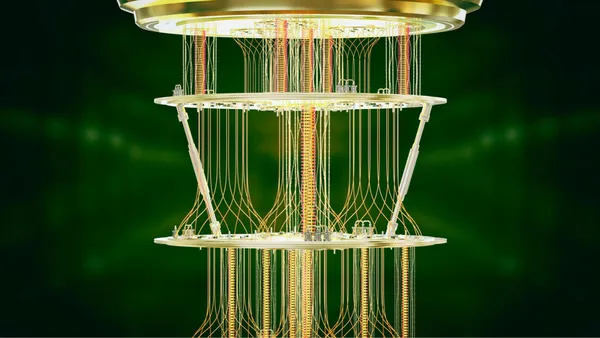
IBM links two Nighthawk quantum processors with four l-couplers at 99% fidelity
IBM researchers have connected two IBM Quantum Nighthawk processors using four meter-scale l-couplers, reaching an average quantum state transfer fidelity of 99%. According to IBM, it is the first time superconducting quantum processors have been linked through multiple quantum channels at this fidelity.
- IBM connected two Quantum Nighthawk R1 processors with four 80-centimeter l-couplers inside a dilution fridge.
- Average quantum state transfer fidelity was 99%, with a peak of 99.3%.
- Distant CZ gates across the modules reached a two-qubit gate fidelity of 94.75% averaged over four links.
- IBM says the design is compatible with Nighthawk and can scale to IBM Quantum Starling and beyond.
- Next steps include better yield, lower error rates and more pluggable l-couplers.
Why quantum computers need to look beyond a single chip
IBM says that scaling quantum computing to much larger systems than exist today will not rely solely on building bigger chips. Instead, the company argues that the future depends on many processors working together, with information moving between them.
In IBM's description, modular quantum computers consist of individual quantum processors joined by meter-scale interconnects inside modular cryogenics, meaning dilution fridges that scale but share a cryogenic environment. For its superconducting processors, IBM calls these long-range interconnects l-couplers, as opposed to the on-chip c-couplers. Earlier this year, the company also debuted a new modular cryogenic platform in which such connected processors will sit.
IBM notes that earlier work, from itself and other groups, offered high-quality proof-of-concept demonstrations of quantum operations between connected modules. According to the company, those approaches were not readily compatible with implementing multiple l-coupler connections between large superconducting qubit processors.
What the experiment achieved
The new work connects two IBM Quantum Nighthawk R1 processors with four l-couplers. Each one uses an 80-centimeter aluminum coaxial cable. Each l-coupler includes the cable, the simplified "l-qubits" it connects to, the tunable couplers linking the l-qubits with the cables, and associated controllers. L-couplers are connected after the processors are mounted in the dilution refrigerator.
IBM says the experiment wired out only a subset of the qubits for development purposes, though the chips themselves are full Nighthawk processors. The reported results include:
- l-coupler modes with internal quality factors of 940,000, in a range IBM describes as appropriate for transferring superconducting quantum information;
- quantum state transfer fidelities of up to 99.3%, with an average of 99%;
- a two-qubit gate fidelity of 94.75%, averaged over the four links, for distant CZ gates built by transferring states across modules.
The distant CZ gate allowed the team to generate entangled states shared between the two modules. IBM also demonstrated using two l-couplers simultaneously to generate independent entangled states.
What comes next and why it matters
IBM states that the design is compatible with Nighthawk and can scale to the fault-tolerant IBM Quantum Starling computer and beyond. The company says connected processors make it possible to run more powerful error correction codes and larger quantum algorithms across higher numbers of entangled qubits.
Error correction is a major focus for IBM's hardware, and the company says it will require meter-scale couplers between neighboring chips. Its next steps include improving the yield and reproducibility of l-couplers, reducing their error rates, and scaling to more l-couplers that can be plugged and unplugged between larger and more complex processors. IBM says it has room to improve all the metrics in its paper and knows the steps required.
The two-qubit gate fidelity across modules, at 94.75%, is lower than the state transfer figure, which fits IBM's own statement that further work is needed. For now, the result is a laboratory demonstration rather than a product. IBM says it will continue research and development as it works to integrate the couplers into a larger system running more advanced workloads, on its roadmap toward modular, fault-tolerant quantum computing.
IBM Research: Modular quantum computing takes shape with l-couplers