Microsoft Behind One in Three Brand Phishing Attempts in Q3 2026, Check Point Says
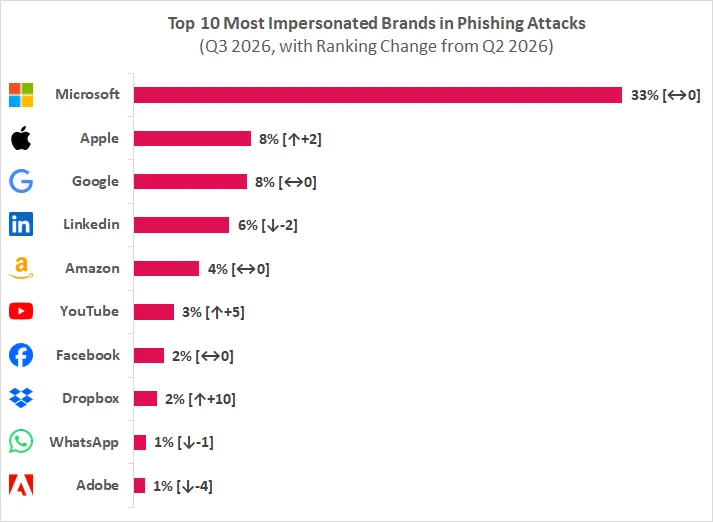
Microsoft was the most impersonated brand in phishing attacks in Q3 2026, accounting for 33% of all brand impersonation attempts tracked by Check Point Research, up from 23% in Q2. The report also describes lures that imitate AI and developer tools such as Claude and Google Antigravity.
- Microsoft accounted for 33% of brand phishing attempts in Q3 2026, up from 23% in Q2, per Check Point Research.
- Apple rose to second with 8%, tied with Google; Dropbox and YouTube entered the top 10.
- Technology was the most impersonated industry, followed by Social Networks and Banking.
- Attackers imitated Claude with a fake payment failure email and Google Antigravity with a malicious install command.
- Fake Apple and Docusign pages tried to get victims to run terminal commands or install remote access software.
Microsoft's lead widens
According to Check Point Research, Microsoft's 33% share is roughly four times that of any other brand. The company says attackers favor Microsoft because stolen credentials can unlock an entire corporate environment, including email, files and collaboration tools. Many of the other top brands, it adds, mainly lead to personal accounts.
Apple, Google, LinkedIn and Amazon completed the top five. Together, these brands made up more than half of all attempts, which Check Point reads as a sign of how heavily attackers rely on a small group of trusted names.
- Apple rose two places to second with 8%, tied with Google in third.
- LinkedIn dropped two places to fourth with 6%.
- Dropbox jumped ten places into eighth.
- YouTube rose five places to sixth. Both entered the top 10 this quarter.
By industry, Technology brands were impersonated most often, followed by Social Networks and Banking. Check Point says this order reflects where people keep their most valuable accounts: work email and cloud storage, social profiles, and their money.
Attackers follow users into AI and developer tools
The report highlights several examples seen this quarter. In the first, a phishing email sent in October 2026 impersonates Claude, Anthropic's AI assistant. It comes from the unauthorized address billing-update@account-notif[.]com and carries the subject line "Payment failed for your Claude account". The message claims a €500.00 payment for the current billing period was declined and warns that API access and Claude seats will be paused unless the payment method is updated. An "Update payment method" button leads recipients into a fraudulent payment process, putting financial details and account credentials at risk.
In the second, the website antigravity-ide-google[.]com, registered in September 2026, impersonates Google Antigravity, which Check Point describes as Google's agentic software development platform. Visitors see a Linux installation command that looks legitimate but decodes and runs a Base64 encoded command. That command downloads and executes a shell script from an external server, giving the attacker remote code execution (RCE) on the victim's system.
Fake support pages and a fake Docusign update
Two further cases show attackers persuading victims to do the work themselves. The website apple-support[.]today, registered in September 2026, closely imitates Apple's official site, with branding, navigation menus and content about Mac performance. Visitors land on an article titled "Boost your Mac using the terminal", which promises better performance through terminal commands. Check Point says the aim is to get users to run malicious commands on their own systems. The legitimate Apple Support website is support.apple.com.
A group of sites impersonating Docusign began appearing in September 2026, the first domain being docusigninstalleradmin[.]help, and continued into early October. A recently active site shows a document awaiting review and signature, plus an "Update Required" prompt claiming a Docusign Reader update is needed. Clicking Continue downloads fleetdeck_installer, a remote management tool. FleetDeck is a legitimate remote monitoring and management (RMM) product, but Check Point says distributing it through a spoofed Docusign site suggests the goal is unauthorized remote access to the victim's device.
What Check Point recommends
Check Point argues that brand impersonation works because it exploits trust in familiar names, not a software flaw. It expects these attacks to keep growing in volume and sophistication as generative AI helps attackers produce convincing emails and fake websites at scale, which makes prevention more valuable than cleanup.
The company's recommendations include:
- Stopping phishing messages inline, before they reach an inbox.
- Using AI powered detection for brand impersonation, business email compromise, credential harvesting, QR code phishing and AI generated attacks.
- Protecting Microsoft 365, Google Workspace and collaboration tools from one platform.
- Automating investigation and response.
- Monitoring for remote management tools that IT has not approved, since attackers can abuse legitimate RMM software.
Check Point also says protection must reach beyond the inbox, through scanning the open, deep and dark web for lookalike domains and cloned login pages, backed by fast takedowns. According to the company, its Exposure Management catches 66% of phishing attacks built on copied pages and resolves takedown requests with a 99%+ success rate, most within 12 hours. These are Check Point's own figures. The company also promotes its Email Security product for inline prevention.