MIT researchers build one AI model for sand, fluids and proteins
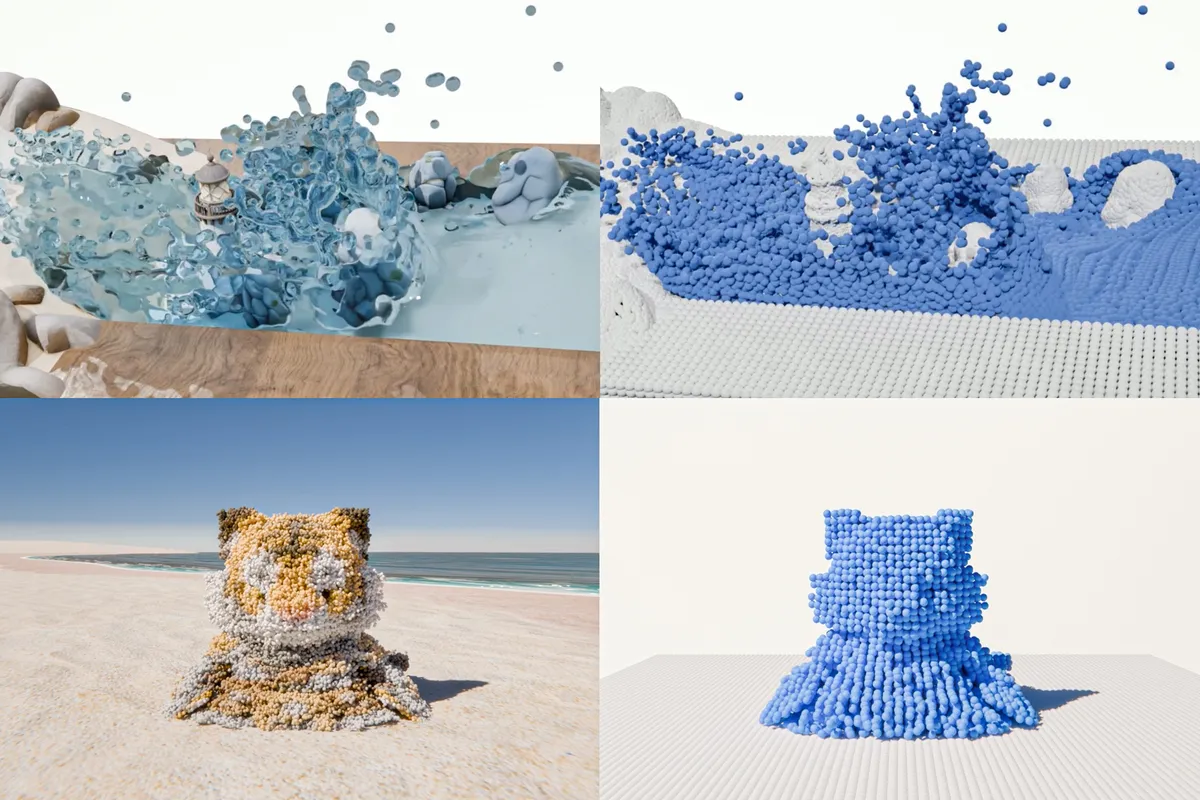
Researchers at MIT, the University of British Columbia and other institutions have developed WorldParticle, a single deep-learning system designed to simulate a wide range of physical phenomena. The model represents materials as particles and predicts how they move, potentially replacing separate simulators for different processes.
- WorldParticle simulates multiple physical phenomena with one AI architecture.
- It represents materials as particles and predicts their motion step by step.
- The system was tested on six phenomena, including proteins and granular materials.
- Researchers report protein simulations about 100 times faster than numerical simulators.
- Future applications include soft robots, RNA evolution and galaxy mergers.
One model for many physical systems
Scientists typically choose a specialized simulator for each physical process. One tool may model flowing water, while another is designed for protein folding. These systems are generally hand-coded around the equations that describe a particular material or process.
WorldParticle takes a different approach. It represents everything from a dune of sand to a protein molecule as thousands or millions of tiny, three-dimensional particles. It then predicts the particles' positions and physical properties one step at a time.
The researchers say this unified architecture could model combinations of physical systems that would otherwise require separate tools. One example is fluid sloshing against a deformable solid, such as oil affecting an elastic valve in a storage tank. The system could also help engineers study how sand or soil moves when contacted by a soft robot.
Learning motion instead of using a new solver
WorldParticle uses a neural network to learn how particles respond to materials, forces and environments. Rather than designing a new numerical solver for every governing equation, the model takes the particles' three-dimensional positions and physical properties as inputs and predicts their states in the next frame of a simulation.
The system also separates external forces before each simulation step, then integrates those forces back into its predictions. According to the researchers, this helps WorldParticle adapt to materials, environmental conditions and forces that were not present during training.
Because complex objects can contain millions of particles, the team developed a merging technique that combines and compresses particles while preserving fine-grained details. This was intended to make the framework more scalable without losing the behavior needed for simulation.
“It is a similar architecture to ChatGPT. But instead of predicting one word at a time to write a piece of text, we are predicting how these particles will move, one step at a time,” Peter Yichen Chen, a former MIT postdoc and now an assistant professor at UBC, said.
Results across six phenomena
The researchers demonstrated WorldParticle on six different physical phenomena, including deformable objects, granular materials and proteins. MIT News reports that the system produced higher accuracy than numerical simulation methods in these tests.
In one example, WorldParticle modeled a granular object collapsing into a pile, while some baseline methods left sand particles floating in the air. The method also modeled changes in protein structures over time about 100 times faster than numerical simulators, according to Minghao Guo, an MIT postdoc and co-corresponding and co-lead author of the research.
The work is described in the open-access paper “WorldParticle: Unified World Simulation of Lagrangian Particle Dynamics via Transformer.” The research will be presented at the ACM SIGGRAPH Conference and Exhibition on Computer Graphics and Interactive Techniques in Asia.
A possible foundation for scientific simulation
Chen said the researchers want to create a foundation model that can work “out of the box” across simulation scenarios. The team hopes WorldParticle will eventually support research into new materials and physical processes that are difficult to study with existing methods.
Potential applications identified by the researchers include soft robot manipulation, RNA evolution and astrophysical phenomena such as merging galaxies. They also plan to develop a broader simulation pipeline for scientific discovery.
For engineers and scientists, the significance of the work lies in combining different physical regimes within one framework. The researchers say that could make it easier to study connected systems and reveal behavior that separate simulators might miss, although the system remains a research project being extended to additional physical systems.