Paper2Agent turns research papers into interactive AI agents
Paper2Agent converts a research paper and its codebase into an interactive AI agent that can run the paper’s methods. The framework packages each agent as an MCP server, tests it against the paper’s results and lets users query it in natural language.
- Paper2Agent turns papers and codebases into interactive MCP servers.
- Each server includes tools, resources and prompts for using a paper’s methods.
- 74 of 100 computational biology papers became working agents.
- The agents scored 91.2% accuracy on 300 benchmark questions.
- Claude Code scored 80.3% with the paper’s GitHub repository, using Sonnet 4.
From passive PDFs to usable research tools
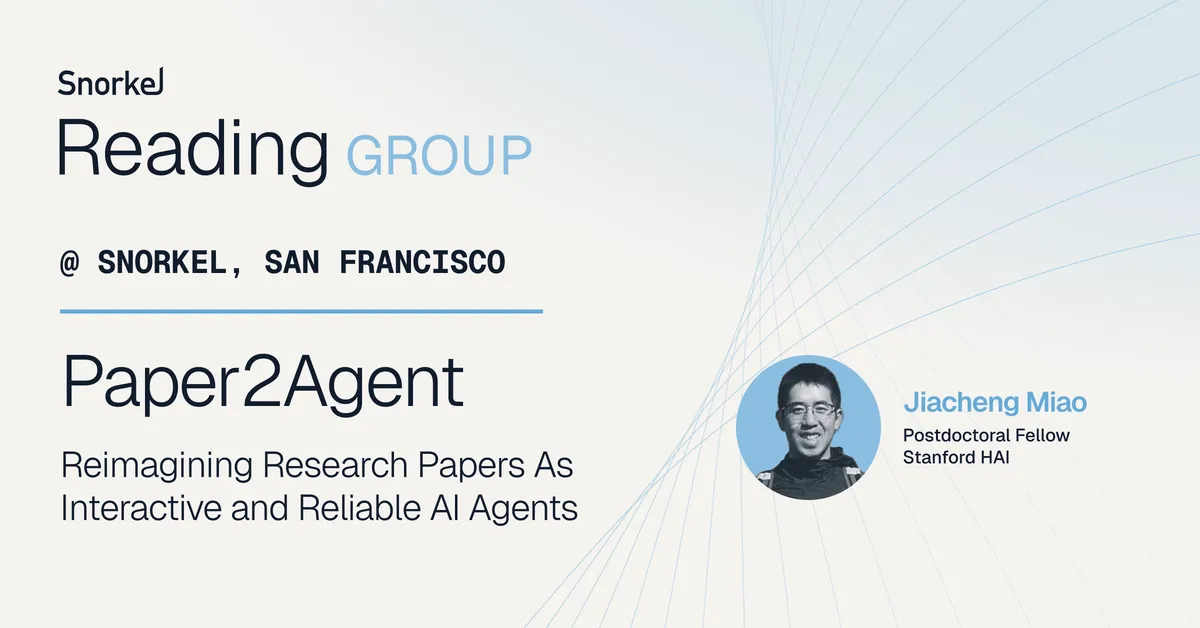
Jiacheng Miao of the Stanford Institute for Human-Centered AI presented Paper2Agent at Snorkel AI’s latest Reading Group. The project addresses a limitation Miao identified in the traditional research paper, which has been used to share scientific knowledge for roughly 350 years.
Researchers often need more than an explanation of what a study found. They may want to apply its training method to new data, test it on their own samples, reproduce its results or combine its method with a separate dataset. Miao described current interaction with papers as “really passive and fragmented.”
His example was DeepMind’s AlphaGenome paper. Understanding and using the work can require reading a PDF of roughly 200 pages, consulting supplementary notes, identifying the training data and working out how to use code and APIs from the project’s GitHub repository. Paper2Agent proposes that researchers release an interactive paper agent alongside the PDF.
How Paper2Agent works
The workflow starts with a paper and ends with an MCP server. Its MCP tools wrap the paper’s computational methods, allowing users to apply them to their own data. MCP resources expose the manuscript, code repository links and training data described in the paper. MCP prompts provide step-by-step instructions for analyses that follow the paper’s methods.
Because coding assistants such as Claude Code connect to MCP servers natively, the format can make a paper’s methods available through tools researchers already use. A user can ask a question in natural language, after which the agent can write code, run an analysis and interpret the results. Miao described this as a “virtual corresponding author.”
The team uses a multi-agent system to improve reliability. Agents identify the codebase, install dependencies and determine which tasks the method can support. Other agents extract benchmark questions from the paper and its GitHub repository, then repeatedly test the resulting MCP server. The process continues as the server is hardened against failures and can reproduce the paper’s reported results, including notebooks in its repository.
Early results and scientific applications
In a test involving 100 computational biology papers, 74 became working agents. Across 300 benchmark questions, the agents achieved 91.2% accuracy, compared with 80.3% for Claude Code given the paper’s GitHub repository. Both systems used Sonnet 4, according to the source.
One demonstrated use case involved AlphaGenome and the task of predicting causal genes from DNA mutations. The paper agent planned which AlphaGenome tools to use, produced tables and figures, and applied biological reasoning to the outputs. It proposed a different gene from the two genes identified through AlphaGenome’s predictions in the paper. Miao said experiments had, to his knowledge, validated the agent’s choice.
The project also points to a possible role for paper agents in checking scientific claims. An agent could compare a published conclusion with independent, model-based evidence and help assess whether a result holds when applied to a complex task. For users, the proposal would make research methods easier to query and apply. For scientific communication, it suggests that papers could be designed for both human readers and agents that use their methods.
Snorkel AI: Paper2Agent: Turning Research Papers Into Interactive AI Agents