Robotics Market Forecast to Hit USD 480.1 Billion by 2034, Report Says
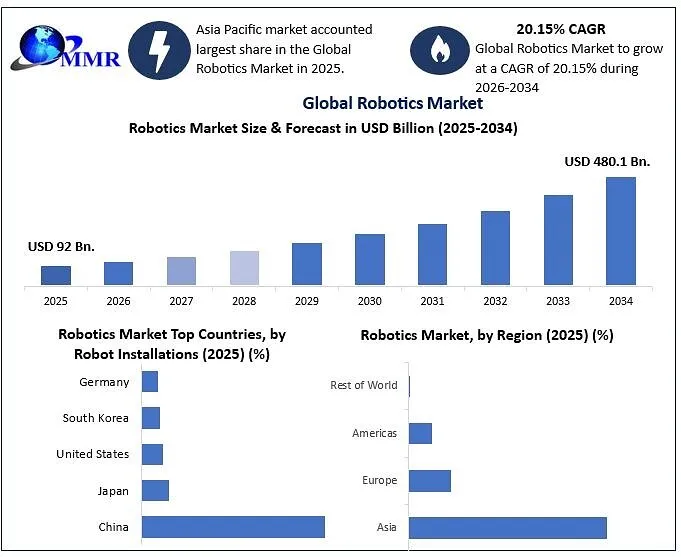
The global robotics market is set to grow from USD 92 billion in 2025 to USD 480.1 billion by 2034, according to a new analysis by Maximize Market Research. The firm projects a compound annual growth rate of 20.15% for 2026 to 2034, driven by industrial automation, AI-powered robots and smart manufacturing.
- Maximize Market Research projects the robotics market will grow from USD 92 billion in 2025 to USD 480.1 billion by 2034.
- The forecast CAGR for 2026 to 2034 is 20.15%.
- Asia-Pacific held the largest market share in 2025, led by China, Japan and India.
- FANUC America announced a USD 90 million, 840,000-square-foot robotics plant in Michigan, due by late 2027.
- Physical AI, humanoid robots and Robots-as-a-Service are named as key opportunities.
What the forecast says
Maximize Market Research, based in Pune, India, puts the 2025 base-year market at USD 92 billion and the 2034 figure at USD 480.1 billion. The report uses 2025 as its base year and 2020 to 2025 as its historical period. The firm says the growth is driven by rising industrial automation, adoption of AI-powered robots, advances in smart manufacturing and demand from the automotive, electronics, healthcare and logistics industries.
The analysis covers industrial robots, collaborative robots (cobots), autonomous mobile robots (AMRs), automated guided vehicles (AGVs), service robots and humanoid robots. According to the firm, labour shortages and a push for greater productivity are also pushing manufacturers toward intelligent automation. The report spans 327 pages and includes 154 market data tables.
Technologies and opportunities
The research firm says the market is being reshaped by artificial intelligence, physical AI, machine vision, precision motion control, robotic automation and autonomous navigation. It lists several areas of opportunity:
- Physical AI and humanoid robotics
- Precision actuators and machine vision
- Autonomous navigation
- Robots-as-a-Service (RaaS) models
By application, the report names handling as a key segment, supported by demand for pick-and-place work, material handling, packaging and palletizing. Welding and soldering and assembling and disassembling are widely used in automotive and electronics production, while dispensing, processing and cleanroom uses support precision manufacturing. By end-use industry, automotive is described as a major segment, driven by robotic welding, assembly, painting and automated production lines. The electrical and electronics sector is adopting robots for semiconductor manufacturing and precision assembly.
Regional picture and a US investment
Asia-Pacific leads the market and held the largest share in 2025, according to the report. It credits China's large-scale industrial robot installations, Japan's advanced robotics manufacturing and India's growing investment in automation. The report also says South Korea benefits from automation in semiconductor and automotive production.
North America and Europe are seeing rising adoption of collaborative robots, warehouse automation and humanoid robotics. Europe's demand is concentrated in Germany, France and Italy, the report says, while the Middle East and Africa are creating opportunities through industrial diversification and logistics automation.
As an example from the United States, the release points to FANUC America, which on March 24, 2026 announced a USD 90 million investment in an 840,000-square-foot robotics manufacturing facility in Michigan. The facility is expected to be completed by late 2027 and to create approximately 225 jobs. The report says it will support future industrial robot production.
What it means for the market
The figures are a market research projection, not a measured result, and they come from the firm's own press release. Still, the report points to manufacturers and robot makers expanding capacity around AI-driven automation. For manufacturers, the analysis suggests that labour shortages and competitiveness concerns will keep pushing investment in cobots, mobile robots and handling systems. For suppliers, it highlights sensors, AI-driven software and service-based models such as RaaS as areas of focus.