Robust AI builds robots designed to work alongside people
Robust AI is building robots intended to complement human workers in logistics warehouses and factories, rather than replace them. Its mobile Carter robot can be guided by people, move autonomously and adapt to changing work environments.
- Robust AI’s Carter robot is designed to work alongside people in warehouses and factories.
- Carter uses a force-sensitive handlebar, AI-powered vision and holonomic wheels.
- The robots help with picking, stocking and autonomous movement of items.
- Robust AI says its systems can be phased into existing operations.
- The company focuses on supporting workers’ primary tasks without obstructing them.
A robot designed to fit around workers
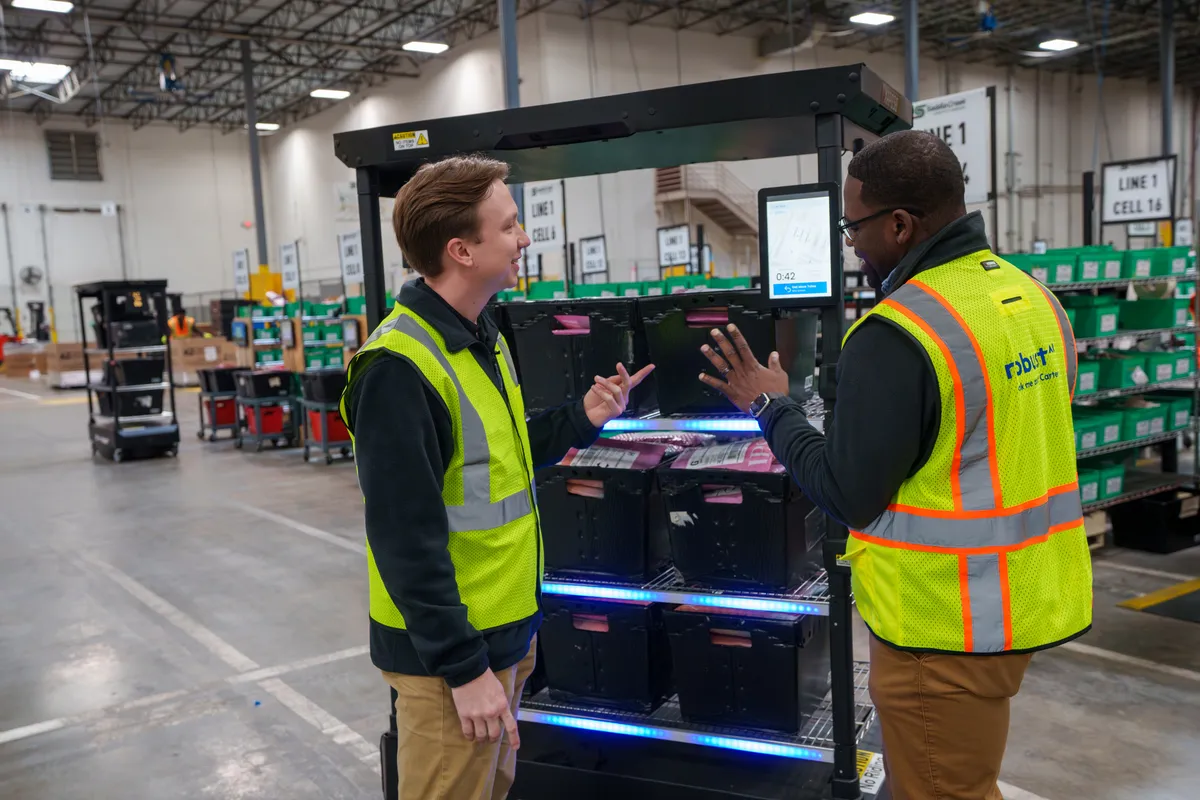
Founded by Anthony Jules ’92, SM ’92 and MIT Professor Emeritus Rodney Brooks, Robust AI develops robots for workplaces where people and machines share tasks. The company’s mobile robot, Carter, resembles a utility cart on wheels and is designed to operate alongside humans in warehouses and factories.
Carter has a force-sensitive handlebar, an AI-powered vision system and holonomic wheels that allow movement in any direction. According to MIT News, workers can cut in front of the robot, push or pull it with one hand, and direct it with gestures or the onboard touch screen.
The robots are currently deployed in logistics warehouses and on factory floors. They help workers pick or stock shelves and move items autonomously across facilities.
Automation that can be phased into existing operations
Robust AI’s founders chose logistics and manufacturing as early target industries after years of interviewing potential customers. The company says its robots can be introduced in stages and support several workflows, including guiding workers to locations where items need to be retrieved and following workers to loading areas.
A main use for Carter is transporting items from one place to another. Brooks, who serves as Robust AI’s chief technology officer, told MIT News that workers in large facilities may need to move materials hundreds of feet between stations. With the robot, a worker can load it, say “done,” and let it carry the items onward.
Jules, now Robust AI’s chief innovation officer, said the company is focused on factories that have little or no automation. He argued that these businesses are unlikely to remove existing operations and replace them with highly expensive systems. Robust AI’s approach is intended to let customers add robots where they are needed, while deciding how the machines fit into their workspace.
Keeping robots out of the way
The company’s development approach is shaped by cases where robots disrupted workers instead of helping them. Leila Takayama, Robust AI’s vice president of human robot interaction, found a peer-reviewed study of robots used in hospitals to gather dishes, move sheets and transport equipment. In many hospitals, the robots were turned off and left against walls after breaking down or obstructing staff.
Brooks told MIT News that nurses moving patients on gurneys could encounter robots that stopped in hallways, making it difficult to pass. Robust AI says it studies workers’ primary tasks and builds features intended to accelerate them, whether the work is performed by a person or a robot.
That focus gives the company’s product strategy a clear workplace goal: people retain control over physical activity that requires flexibility, while the robot handles repeatable movement and transport. According to Jules, success depends on the combined performance of the robot, human workers and backend systems, with people retaining an appropriate level of agency and input.
MIT News: Helping robots fit into the human workplace