Salesforce brings Informatica data intelligence to Microsoft AI tools
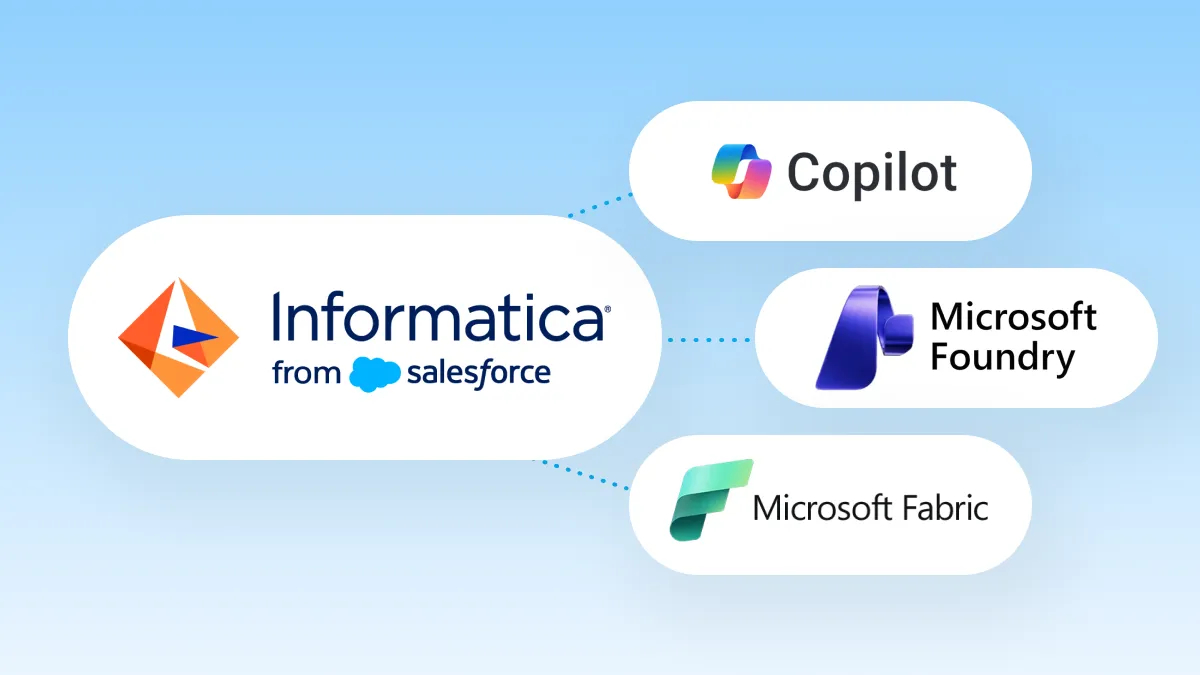
Salesforce is expanding Informatica’s collaboration with Microsoft to bring enterprise data intelligence into Microsoft Copilot, Microsoft Foundry and Microsoft Fabric. The integrations are designed to give business users and AI developers access to data definitions, quality signals, lineage and governance controls.
- Informatica data intelligence is being integrated into Microsoft Copilot and Teams.
- Microsoft Foundry gains expanded Informatica MCP governance, identity and administrative capabilities.
- Fabric scanning now includes notebooks and data pipelines.
- A new U.S. East Coast Azure point of delivery expands deployment choice.
Trusted context for Copilot users
Announced at Microsoft Ignite 2026, the collaboration extends Informatica’s enterprise data management capabilities into Microsoft Copilot and Microsoft Teams. Through Informatica Headless capabilities, Copilot experiences can use information from Informatica’s data catalog, business glossary, metadata, lineage, quality indicators and governance services.
That context is intended to help employees understand more than which information exists. Users can also assess what data means, where it originated, how trustworthy it is and how it should be interpreted. Salesforce said this could help business professionals work with authoritative information through natural-language experiences.
Informatica gave the example of a marketing manager using Copilot to create a campaign for a customer segment. The user could identify relevant datasets, assess their quality, review lineage and provenance, and check access controls for sensitive information, including Personally Identifiable Information, or PII.
Governed agents in Microsoft Foundry
The expanded integration also adds governance, identity and administrative capabilities to Informatica Headless MCP services in Microsoft Foundry. Developers can use standardized Model Context Protocol interfaces to connect agents with Informatica’s data management capabilities rather than building custom integrations.
According to Salesforce, Foundry developers can ground agents in authoritative business definitions, quality indicators and lineage. They can also apply identity, access and administrative controls, while tracing agent interactions with enterprise data management services.
The integration is intended to support agents working across systems and environments beyond Microsoft Azure. Salesforce said Informatica’s MCP services are becoming available across Azure-based IDMC points of delivery worldwide, allowing more organizations to incorporate governed enterprise data into Foundry applications and agents.
Broader governance across Microsoft Fabric
Informatica is expanding its Microsoft Fabric scanning capabilities to include notebooks and data pipelines. The change extends governance visibility from data at rest to the orchestration and transformation processes that shape enterprise information.
The enhanced scanners provide lineage visibility across data movement and transformation workflows, including multistep pipeline orchestrations. Customers can use this information to trace data through Fabric notebooks and pipelines, understand dependencies and assess the impact of changes across Fabric environments.
Salesforce said the resulting lineage, provenance and governance information can also enrich the context available to AI agents through Copilot and Foundry. The company is additionally expanding its Azure footprint with a new U.S. East Coast point of delivery, giving enterprises another deployment option for regional data residency and compliance considerations.
“The next frontier of enterprise AI isn’t simply giving every employee an intelligent assistant or every developer the ability to build agents,” Savinay Berry, EVP and General Manager, Data Management, Salesforce, said. “It’s ensuring that those assistants and agents understand the business they’re operating in.” The announcement addresses a governance gap Salesforce highlighted with data from Deloitte’s 2026 State of AI in the Enterprise report: 85% of organizations expect to customize AI agents for their business needs, while 21% of organizations planning agentic AI deployments report having mature agent governance models.