Sungrow launches PowerStack 3.0 C&I energy storage platform
Sungrow has launched PowerStack 3.0, a commercial and industrial energy storage system designed to combine modular hardware with AI-powered support across a project’s lifecycle. The company says the global-market product replaces a traditional All-in-One approach with a scenario-focused “Scene-in-One” architecture.
- PowerStack 3.0 targets commercial and industrial energy storage applications.
- Its multi-scenario dock includes PCS, Solar, Charging and Microgrid modules.
- Bubbly supports design, commissioning, optimization and maintenance tasks.
- Sungrow claims energy density of up to 256 kWh/m² and 99.2% maximum conversion efficiency.
- The system supports up to 20 units in parallel and a 0ms seamless switchover.
A modular system for different applications
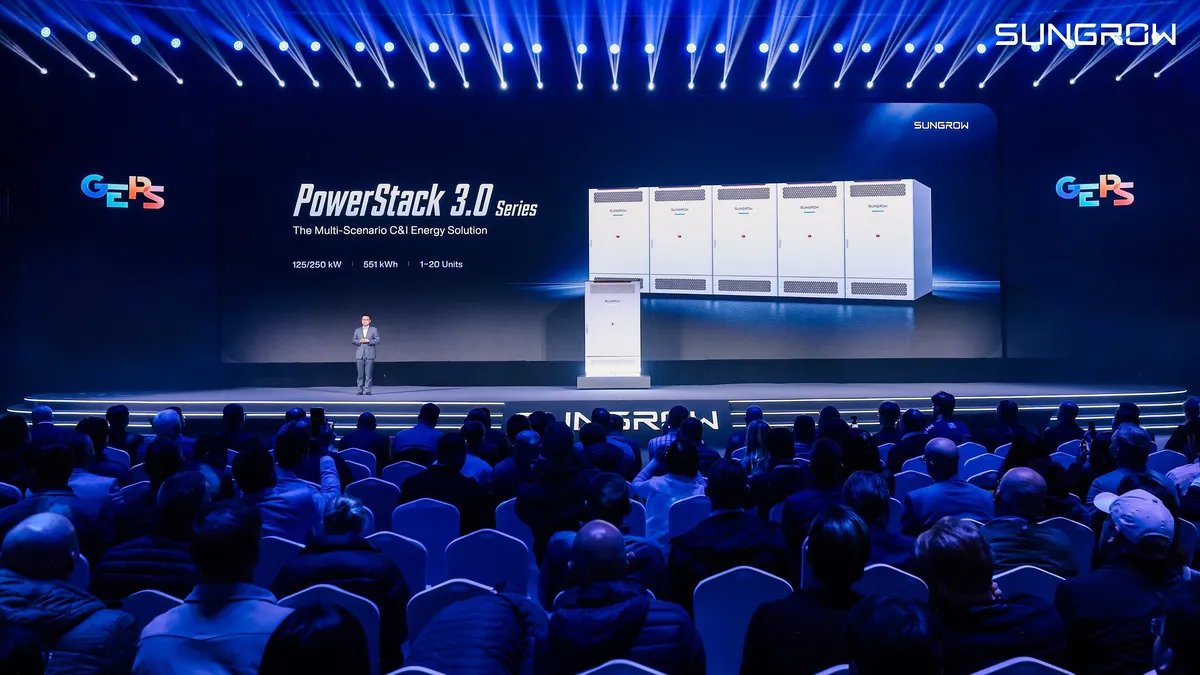
Unveiled at the Global Energy Pioneer Summit 2026, PowerStack 3.0 introduces what Sungrow describes as an industry-first multi-scenario dock. It contains four dedicated modules: PCS Module, Solar Module, Charging Module and Microgrid Module.
The architecture is intended to let users configure systems around specific application requirements. In standalone energy storage, different PCS power-module combinations support 2-hour and 4-hour configurations. For PV-plus-storage projects, the PV-storage module allows the energy storage PCS to handle PV power conversion, removing the need for an additional inverter, according to Sungrow.
Adding the EV charging module enables DC coupling across the PV, storage and charging chain. The microgrid module is designed to maintain power to critical loads during grid outages and provides what Sungrow calls a 0ms seamless switchover from grid-connected to off-grid operation without a separate static transfer switch cabinet.
Bubbly brings AI into project operations
PowerStack 3.0 integrates Bubbly, Sungrow’s proprietary AI assistant, across planning, commissioning, operation and maintenance. The company says Bubbly can combine satellite images with 3D modeling to produce a design proposal, including technical designs, installation layouts and financial calculations, in 30 seconds.
During commissioning, Bubbly supports automated plant configuration and data validation, with Sungrow saying the process can be completed in 3 minutes. The assistant also uses PV generation and load forecasts to optimize self-consumption, demand control, arbitrage and frequency regulation. Compared with conventional self-consumption mode, the resulting dispatch strategy can increase returns by more than 12%, according to the company.
For maintenance, Bubbly continuously monitors system conditions, identifies more than 30 potential risks and can produce a fault diagnosis report with recommendations in 1 minute for a 10 MWh plant.
Higher density and protection for C&I sites
Sungrow says PowerStack 3.0 reaches an energy density of up to 256 kWh/m² and supports side-by-side, back-to-back and face-to-face installation layouts. Up to 20 units can be connected in parallel. For a 5 MWh plant, the company says the system reduces the required footprint by 43% compared with the previous generation.
The system is rated IP55 for ingress protection and C5-level for corrosion protection, and is designed to operate from -30°C to 50°C while tolerating up to 30% grid harmonics. Its self-developed SiC PCS has a maximum conversion efficiency of 99.2%, while the 684 Ah stacked cell delivers a round-trip efficiency of more than 92%, according to Sungrow.
The company says a simplified architecture, three-level fuse protection and a four-layer fire safety design are intended to reduce failure points and help manage risks. “Today, we have entered the 3.0 era, the scenario-driven era,” said Dr. Cao Wei, GM of Sungrow’s C&I ESS Product Line.