USC Researchers Build EVAC-AI to Improve Los Angeles Wildfire Evacuations
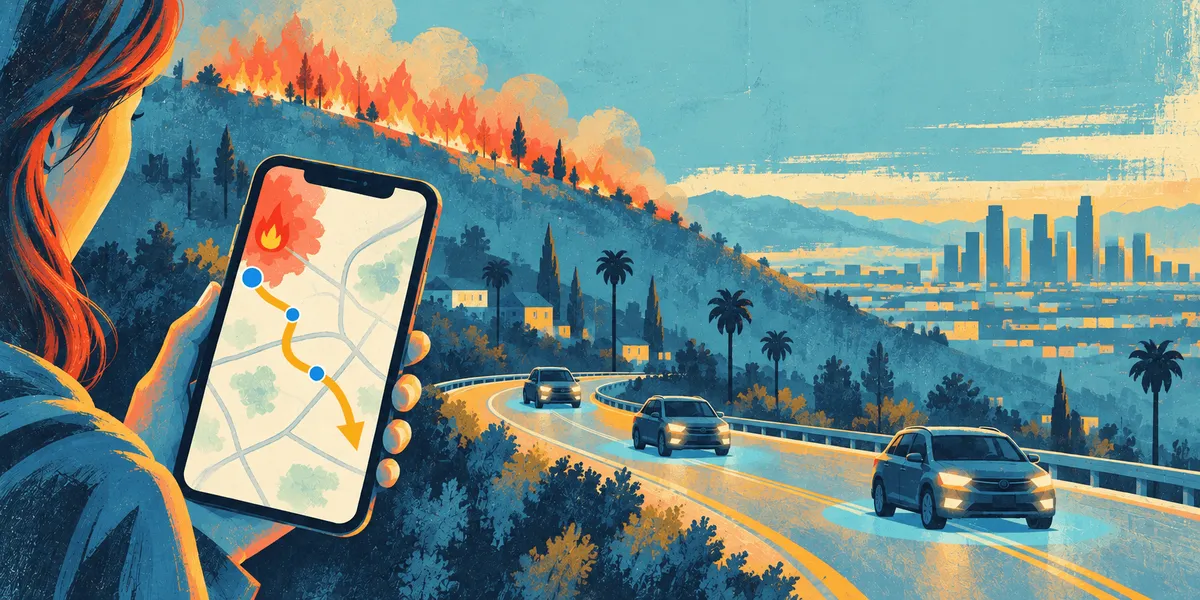
USC researchers are developing an agentic AI framework designed to help Los Angeles coordinate wildfire evacuations in real time. Called EVAC-AI, the four-year project will connect fire behavior, transportation networks, emergency response and human mobility in one system.
- USC researchers are developing the four-year EVAC-AI project.
- The system will link fire forecasts, roads, emergency response and human mobility.
- Updates are envisioned every five minutes at the census tract level.
- A resident facing interface could answer wildfire evacuation questions.
- The team will study autonomous vehicles as a potential rescue resource.
A response to evacuation failures
The project follows the 2025 Los Angeles wildfires, when delayed warnings, alerts sent to the wrong neighborhood and traffic-clogged routes turned evacuation into a crisis of its own, according to USC Viterbi.
The university says the city’s existing evacuation system struggles to coordinate fire conditions, traffic and residents’ movements as they change. Led by USC assistant professor of civil engineering Ruolin Li, the research team aims to help emergency managers anticipate bottlenecks and intervene before they become crises.
“Our goal with EVAC-AI is to approach evacuation as one interconnected system rather than a collection of separate problems,” Li said, according to USC Viterbi.
The project is funded by the National Science Foundation’s Focused Interdisciplinary Research in Engineering program. The research team also includes Yue Zhao, Ketan Savla and Costas Synolakis.
Linking fires, roads and residents
EVAC-AI will use probabilistic fire modeling, including the possibility of ember-driven spot ignitions, to translate changing fire conditions into information about which roads remain accessible. The researchers envision updates every five minutes at the census tract level, allowing transportation conditions to change alongside the fire.
The framework will account for human-driven and autonomous vehicles, including vehicles operated by Waymo. Its mixed-autonomy model will examine whether centrally dispatched autonomous vehicles can serve as a rescue resource, while including a constraint intended to guarantee coverage for households without personal vehicles.
The system will also explore targeted and staggered evacuation instructions rather than a single mass alert. The aim is to reduce pressure on road networks while preserving routes for emergency operations.
USC says current approaches can overlook individual circumstances, including the needs of elderly people, people with disabilities and households without cars. Fire prediction models may also fail to account for the way spot ignitions can make roads inaccessible ahead of the visible fire perimeter.
A resident facing AI interface
At the center of EVAC-AI will be a two way agentic AI system. Emergency managers will receive real time information and recommendations, while residents will be able to provide details about their circumstances that feed back into the broader evacuation picture.
The team plans to create a Los Angeles resident facing interface or app that works much like ChatGPT, but is designed for wildfire evacuation questions. Residents could ask what to pack or which route to take, and report whether they have a vehicle, care for an elderly family member or need to evacuate with pets.
The researchers will also explore centrally coordinating commercial autonomous vehicle fleets to pick up residents who lack transportation or require specific accommodations. The project’s purpose is to investigate how existing transportation infrastructure could move people to safety more effectively, rather than simply moving more cars. EVAC-AI remains a research project, and USC describes these capabilities as goals the team plans to develop and explore.
USC Viterbi (AI): Can AI Agents Help Los Angeles Evacuate Faster During Wildfires?