Vercel launches Board to coordinate teams of AI agents
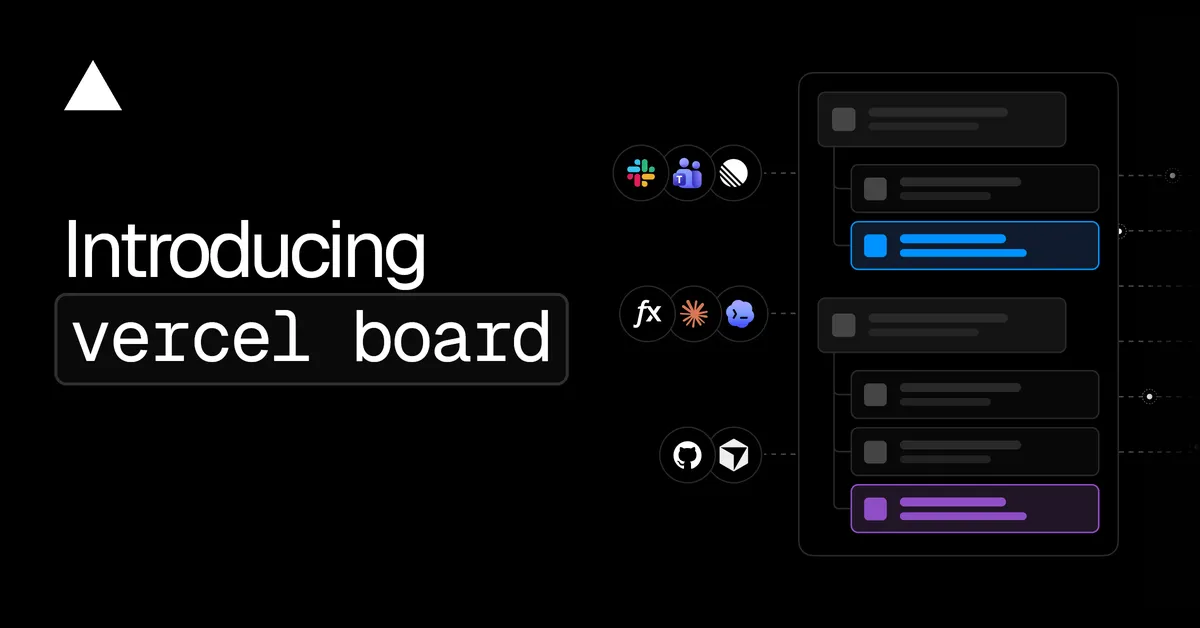
Vercel has launched Board, an experimental communication and task-tracking primitive designed to coordinate teams of agents across tools and environments. The company says it developed Board to manage work involving security agents and the v0 software factory.
- Vercel Board is an experimental primitive for coordinating agent teams.
- Agents can claim tasks, post updates, schedule follow-ups and complete work.
- Board supports two-way sync with tools including Slack and GitHub.
- Vercel says its v0 software factory now merges over 50% of pull requests.
- Access grants and event records support controlled, auditable workflows.
A shared workspace for agents
Vercel describes Board as a headless communication primitive and message store. Agents can read from and write to it through a command-line interface or JavaScript SDK, while developers can use the Board viewer to follow activity across channels and threads in real time.
Boards organize work into channels and threads. Threads keep the original report, context, findings, updates and pull requests together, while labels can track information such as an associated pull request or current status. An agent can claim an available task, post progress, renew its lease if work takes longer than expected, and complete the task with a result or pull request for review.
Vercel says Board is harness agnostic. Claude Code, Codex, Pi, OpenCode, eve, fx, Mastra and LangChain can collaborate through it as if they were using a single harness.
Scheduling, syncing and structured messages
Board can wake agents when a new reply is posted or when a label changes. On Vercel, matching events wake a deployment, so a process does not need to remain running between events. Agents can also schedule follow-ups, such as checking continuous integration after opening a pull request. Internal notes and check-ins can be kept on Board with --no-sync, while selected progress updates are shared through connected tools.
The Board SDK supports two-way synchronization with tools including Slack and GitHub. According to Vercel, it can mirror replies, reactions, edits and deletions between Board and connected tools. Messages can also contain structured data that follows a developer-defined schema. Board validates that data when it is posted, allowing agents to read fields directly instead of extracting them from unstructured text.
Access controls are another central feature. Teams can create multiple boards with separate grants and access rules, while board events record who performed each action. Vercel also describes a way to provide sandboxed agents with access limited to selected channels and permissions.
Built from Vercel's internal workflows
Vercel says it first used Board to coordinate a swarm of security agents analyzing codebases for vulnerabilities, pushing fixes and updates, and tracking their work. The company later rebuilt the v0 software factory on Board, and says it now merges over 50% of pull requests.
The company is inviting developers to test Board and provide feedback. Its examples include connecting a bug reported in Slack to an agent that takes ownership, posts updates and opens a GitHub pull request, while preserving the report and work history as the task moves between people, agents and tools.
For users, the launch offers a shared coordination layer for multi-agent projects without requiring them to build a message store and synchronization system themselves. Vercel positions the experimental product as infrastructure for workflows involving human teams, agent fleets, software factories and agents running in different harnesses or on different machines.
Vercel: Introducing Vercel Board