Vercel Workflow SDK 5 adds encryption, regional runs and faster agents
Vercel has released Workflow SDK 5, an update focused on securing durable workflows, keeping runs closer to users and reducing overhead for agent workloads. The company says the SDK has processed more than 4 billion steps and 700 million runs since its launch.
- Workflow SDK 5 encrypts workflow payloads with AES-256-GCM.
- Runs receive a home region across Vercel Function regions.
- A redesigned trace viewer adds search, zoom and a minimap.
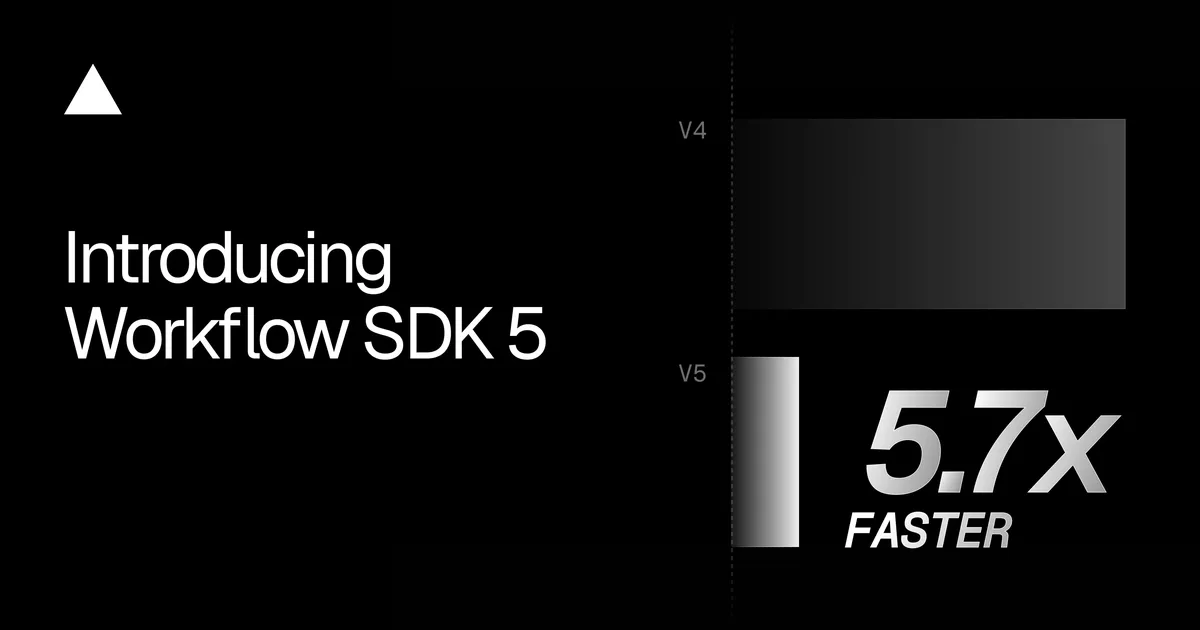
- Vercel reports 1.6× to 25× improvements across measured workloads.
- More than 4 billion steps and 700 million runs have been processed.
Encrypted workflow data by default on Vercel
Workflow SDK uses an event log to store step arguments and return values, allowing a run to recover after a crash or deployment. Vercel says those records can contain customer information, model context, credentials and tool-call results, so version 5 encrypts every payload end to end before it leaves the application.
Workflow and step inputs and outputs, hook payloads and stream data use AES-256-GCM, with a unique key for each run. On Vercel, the encryption requires no setup or code changes. The platform only sees and stores ciphertext, while plaintext is decrypted in the deployment or in authorized observability tools.
Names, timings and statuses remain visible for observability. Authorized users can decrypt payloads in the dashboard or CLI, with decryption taking place in the browser or terminal. Vercel says access follows the project’s environment variable permissions and every request is recorded in the team audit log. Self-hosted Worlds can also use the SDK’s encryption by providing a stable 32-byte key for each run.
Runs can stay in the region where they start
Workflow SDK 4 stored every run in iad1, even when an application was deployed across multiple regions. In version 5, Vercel says Workflow infrastructure is available in every Vercel Function region. Each run has a home region for its state, queue dispatch and streams, avoiding cross-region requests on the hot path.
By default, a run starts in the region of the function that starts it. Developers can also pass a region to start(), allowing workflow data to stay near a database or in a required location such as Frankfurt. Steps still run where the application is deployed, so developers need to deploy there as well if they want execution in that region. Existing v4 runs remain in iad1.
Vercel says regional isolation means a disruption in one region does not have to stop new runs in healthy regions. With Function failover configured, steps can execute in a fallback region while the run’s state remains pinned to its original home region.
A redesigned viewer and lower overhead for agents
Version 5 introduces a redesigned trace viewer with span search, zoom, a minimap and local inspection during development. Run attributes provide searchable context, such as an order ID, although Vercel says those attributes are plaintext and should not contain secrets. Developers can also configure experimental payload retention so inputs, outputs and stream contents are deleted when a run completes or fails, while metadata remains visible.
The update also targets agents and harnesses, which can involve long-running loops, sequential events, token streams, tool chains and dynamic subagents. Vercel says it rewrote parts of the engine to reduce queue hops, networking and CPU work. Across its measured workloads, the company reports latency and overhead improvements of 1.6× to 25× when comparing v5.2.0 with v4.8.12 on Vercel.
Vercel also says it fixed dozens of rare runtime bugs and race conditions and that Workflow SDK 5 recovers from more intermittent network errors. According to the company, it has seen almost no runs fail or stall because of a platform or runtime bug. The result is an update aimed at production automation as well as the increasingly demanding workflows used to build AI agents.
Vercel: Workflow SDK 5: built for production