Action Recognition Beats Tracking for Small, Fast Video Movements
Action recognition performed best for fast, subtle movements in Roboflow’s tests, while detection and tracking, or pretrained keypoints, were better suited to visible objects and body poses. The comparison covered an F1 pit stop, basketball and workout repetitions using held-out video clips.
- Action recognition scored 62 in the F1 pit stop test, versus 49 for detection.
- Action recognition caught all 5 tested basketball dribbles.
- Keypoints and tracking scored 96 for workout repetitions.
- The pit-stop action model improved after sampling video at 8 fps.
- Roboflow recommends choosing the method based on the video question.
Three tasks, three different winners
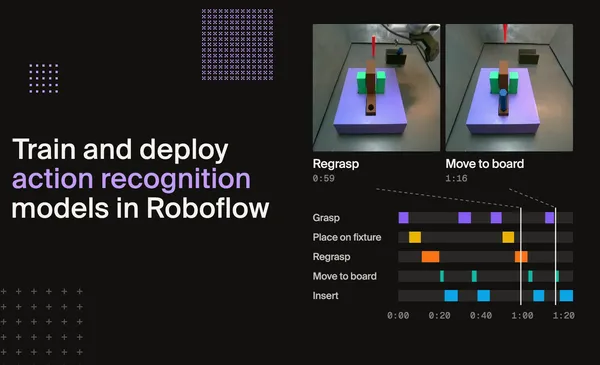
Roboflow built action recognition and tracking-based systems for the same three tasks, then evaluated them on held-out clips. The action recognition models analyzed video clips to identify what happened and when. The alternative used object detection or keypoints, tracking and rules.
Action recognition won the F1 pit stop test with a segment F1 score of 62, compared with 49 for detection. It also led in basketball, scoring 56 versus 38 for detection. For workout repetitions, keypoints and tracking scored 96, compared with 56 for action recognition.
Roboflow says the scores range from 0 to 100. A prediction counted when it had the correct label and overlapped the real action by at least half.
Why small movements favored action recognition
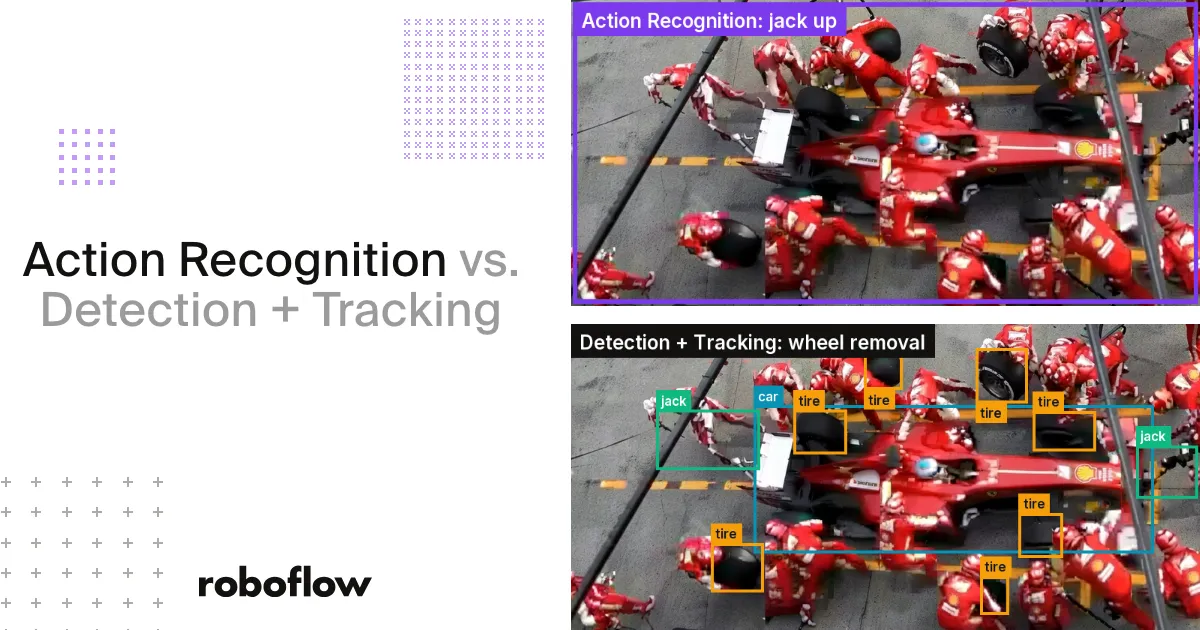
The F1 pit stop takes about three seconds and includes six steps. The jack lifts the car a few centimeters in about a quarter of a second, while crew members can block its view. The detection and tracking system did not catch a single jack step because the car’s box barely moved and the jack was obscured.
The first action recognition version also missed the movement because it sampled video at 4 frames per second. Roboflow retrained the same model at 8 fps, changing nothing else, and the updated system became the best pit stop system overall. Tracking remained more effective for visible events such as checking whether the original tire was still on the car.
Basketball showed a similar pattern. A rule-based system caught 1 of 5 dribbles, while action recognition caught all 5. The action model also learned made shots from 13 training examples, without needing to locate the ball or rim during the entire event.
Keypoints handled exercise repetitions
For workouts, Roboflow used a pretrained RF-DETR keypoint model without fine-tuning. It provided 17 points per person, allowing rules to identify exercises from body geometry. A push-up was defined by the torso tilting more than 40° from vertical, while a jumping jack was identified when the wrists rose above the shoulders. Squats and lunges were counted when the hips dipped, with different knee heights distinguishing a lunge.
These rules counted every repetition with zero training. Action recognition was nearly perfect at identifying the exercise, but merged ten jumping jacks into one long segment, so it could not count repetitions by itself. Roboflow recommends using keypoints for questions about body pose, tracking for visible objects and locations, and action recognition for movements that unfold across several frames.
For action recognition, the company advises labeling dozens of clips per action, increasing the video sampling rate for actions lasting a second or less, and adding a counter when repetitions are needed. Its tests also suggest that a practical system may combine methods, such as tracking tires while using action recognition for pit-stop jack movements.
Roboflow: Action Recognition vs. Detection + Tracking: When to Use Which