Databricks launches AI Index tracking enterprise model costs and usage
Databricks has launched the Databricks AI Index, a public resource tracking enterprise AI model adoption, coding-agent performance and spending. The company says the index will receive weekly updates as it evaluates new proprietary and open-weight models.
- Databricks has made its AI Index public with weekly updates.
- Open-weight models' enterprise token share rose from 7.3% to 30.9%.
- 64% of Unity Gateway enterprises used one provider in July, falling to 28% by November 2.
- GPT-6 Luna and Claude Opus 5.5 had the same 89.1% task success rate but different costs.
- The median AI user spent $2.49, compared with $699.74 for the 99th-percentile user.
A public view of enterprise AI usage
The index combines aggregated, anonymized data from more than 10,000 companies using Unity Gateway, including digital natives, Fortune 500 and Global 2000 enterprises. Its data covers traffic to external providers such as Anthropic and OpenAI, as well as proprietary and open-weight models.
Databricks said the resource measures model adoption through token and spend shares, while also tracking weekly AI spending patterns for individual users. It is publishing the internal evaluation suite permanently, after customers repeatedly asked how new models compare and how enterprise adoption is changing.
The company said a new flagship proprietary or open-weight model has launched roughly every week since May 2026, or every 3.7 days when regional labs are included. That pace has made model selection, cost comparisons and decisions about when to switch more difficult.
Model choice is becoming more fragmented
Databricks reported that enterprise model preferences have shifted sharply. In July, approximately 64% of enterprises using Unity Gateway relied on one model provider. By November 2, that figure had fallen to 28% as more organizations adopted models from two or more providers.
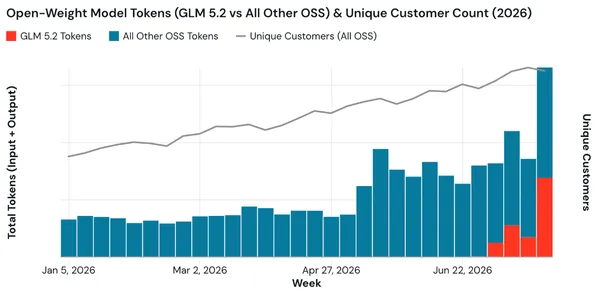
Open-weight models also increased their share of enterprise token traffic, from 7.3% in July to 30.9% in November. Three open-weight models ranked among the top 10 in Databricks' coding quality benchmark. DeepSeek V4.1 and GLM 5.3 both ranked third with a 93.1% pass rate.
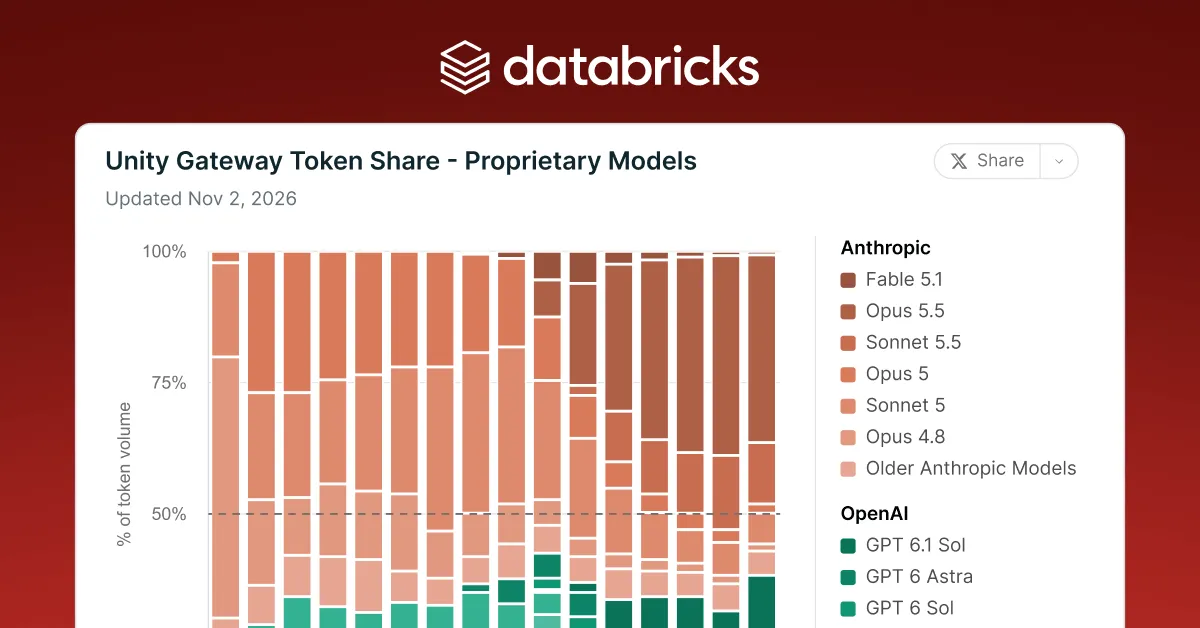
Provider momentum also changed quickly. Databricks said Claude Opus 5.5 rose from 7.2% to 37.9% of proprietary-model tokens in six weeks, while Anthropic's overall share increased from 57.6% to 68.8%.
Cost depends on more than token prices
The coding-agent evaluations use real workflows from Databricks engineers, including creating and reviewing pull requests, investigating issues and handling complex development tasks. The benchmark tests models across nine AI labs using Claude Code and Codex, and compares combinations of models and harnesses by task success rates and cost per completed task.
Databricks found that GPT-6 Luna and Claude Opus 5.5 both achieved an 89.1% task success rate, but averaged $0.05 and $1.62 per task respectively. Gemini 3.8 Flash had a low token price, yet averaged 140 turns per task and reached $11.97 per task.
The findings suggest that enterprises need to assess their own workloads rather than rely on model rankings or token prices alone. Databricks said intelligent routing, including Smart Routing in Unity Gateway, can help match tasks with models according to quality and cost. Its data also showed a wide spending gap among users: the median user spent $2.49 on AI, compared with $699.74 for the 99th-percentile user.