Harvey Builds Agentic Retrieval System for Patent Research
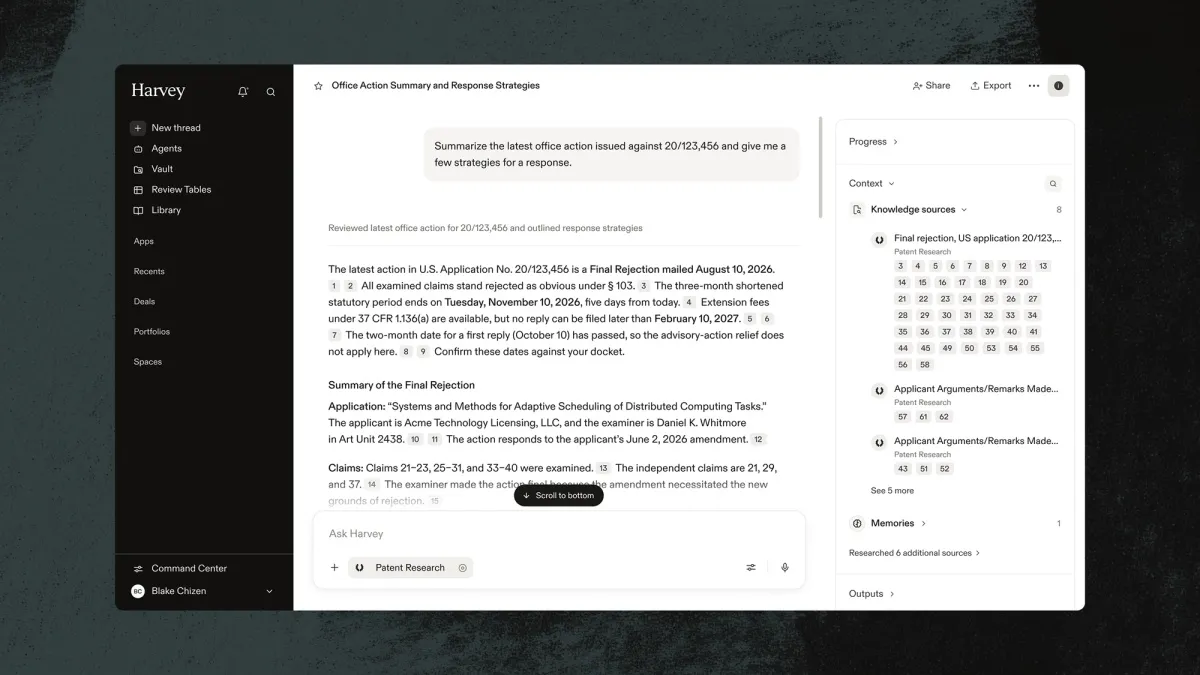
Harvey has detailed an agentic retrieval system for patent research that follows fragmented records, chooses sources and determines what to inspect next. The company says the agent can pursue a question until it produces a cited answer, identifies an unresolved gap or reaches its bounded research budget.
- Harvey’s agent follows patent records across multiple sources.
- Research objectives determine the information the agent must find.
- Routing guidance defines source strengths, boundaries and fallbacks.
- The agent stops with a cited answer, an unresolved gap or at its research budget.
- Users can attach Patent Research as a knowledge source in Harvey.
Why patent research needs more than search
Patent questions often depend on a record’s history rather than a single document. A question about a claim may require researchers to examine how the claim changed during examination, how an applicant addressed prior art and whether later proceedings affected its status.
Harvey contrasts this work with a conventional retrieval-augmented generation system, which searches a fixed index, selects relevant passages and generates an answer. That approach can work when the required information is in one collection and the research path is predictable. In patent research, however, one result can reveal another record or fact that must be checked.
For example, answering what claim 8 covers may require the issued claim, the application’s original language, the applicant’s distinction from prior art and the claim’s current status. Harvey’s system is designed to follow those connections instead of treating the task as a single search.
An agent that selects sources and changes course
Each task begins with a research objective. Harvey says the agent preserves the user’s full question, including patent numbers, claim numbers, timing and legal context, then identifies the information needed to answer it.
For recurring tasks, the system provides concise research paths. A current-claim-status task can move from an issued claim to reexamination or PTAB history and then to a controlling certificate or decision. Research into art applied by an examiner can move from an Office Action record to substantive rejection reasoning and a cited reference. Other paths cover PTAB outcomes and prior-art research.
These paths are information requirements rather than fixed source assignments. The agent receives a routing table for the sources enabled in a run. Each source describes the data it contains, the information needs it serves best, its boundaries and possible fallback sources. Harvey says the routing guidance prioritizes the USPTO for U.S. patent text and identifies Google Patents as an alternative when the USPTO is unavailable in the run.
A shared retrieval layer for patent workflows
As the agent reviews results, its research path can change. A result may reveal a new information need, point to a fallback source or show that the objective is supported. For the claim 8 example, the agent would inspect the issued text, follow relevant reexamination or PTAB records and reconcile the results.
Users can currently attach Patent Research as a knowledge source in Harvey, according to the company. Harvey says its objective, required information and eligible sources model provides a stable way for workflows to request information without being tied to one provider.
The company says the approach could eventually extend to non-patent literature, international patent-office records, licensed sources and authorized private records. That would give workflows a common way to request information while allowing the agent to select among available sources, although Harvey presents these extensions as a future direction.
Harvey: How We Built Agentic Retrieval for Patent Research