Apax’s Jason Wright Says Investors Should Augment, Not Outsource, Judgment
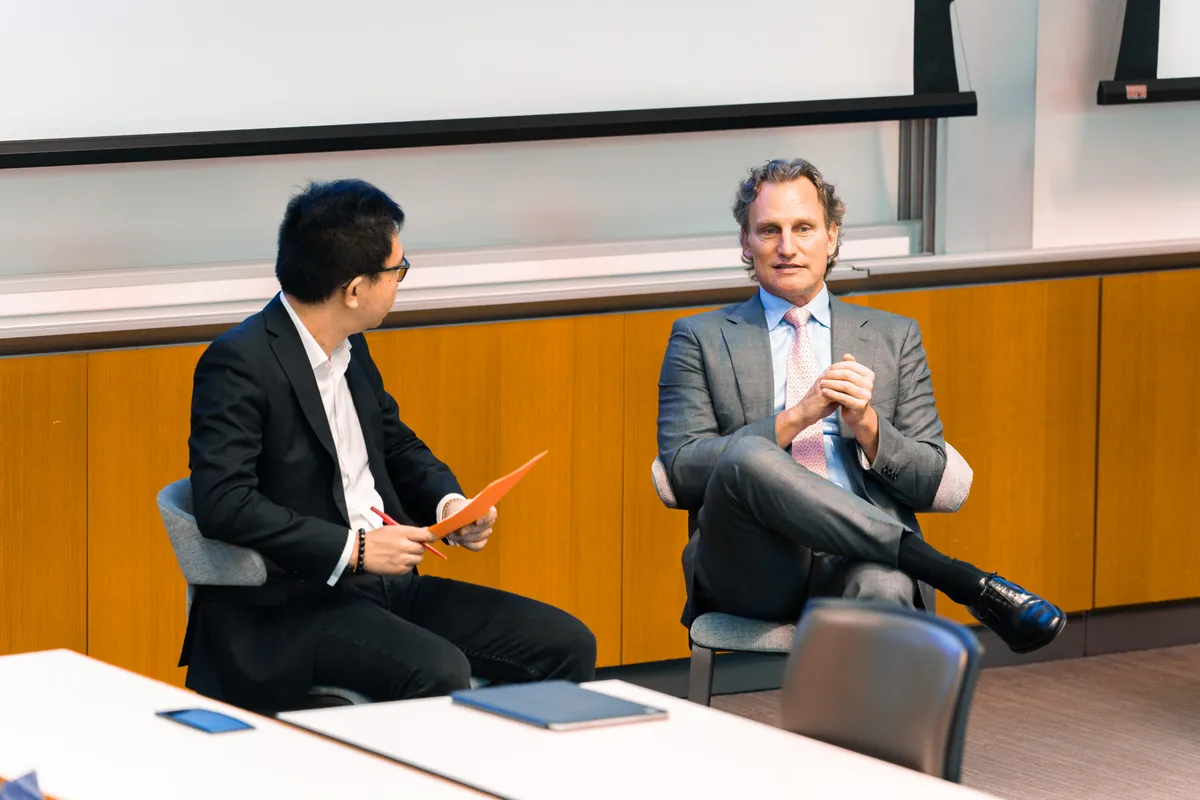
AI is changing how investment teams work, but it has not removed the need for human judgment, according to Jason Wright, a partner at Apax Partners. Speaking at the Wharton AI in Finance Lab’s inaugural event, Wright urged students to use AI to extend their thinking rather than replace it.
- Jason Wright called the current AI cycle unlike previous technology shifts.
- Apax has kept the same number of engineers while increasing output with AI.
- An Apax research project now produces a 25-page first draft in two hours.
- Wright said AI will not replace human judgment or the firm’s apprenticeship model.
- He advised students to gain practical experience and keep developing human skills.
A technology shift with an uncertain outcome
Wright has invested through the internet boom and bust, the mobile wave and the rise of cloud computing. He told Winston (Wei) Dou, faculty director of the Wharton AI in Finance Lab, that the current AI cycle is “nothing like the other three.”
Earlier technology shifts were largely financial opportunities for companies, Wright said. AI is different because it includes “software that writes itself,” making the outcome harder to predict. His advice was to reserve some humility and recognize that patience can be a strategy. For students, he suggested, this may be a useful time to observe how the landscape develops.
AI is increasing output at Apax
Wright prefers the term “augmented intelligence” to “artificial intelligence.” He said “artificial” can sound fake, while “super intelligence” suggests something smarter than everyone. “Augmented” offers a more hopeful framing that still relies on the people using the technology.
At Apax, AI has not yet reduced the number of engineers or produced significant AI-related savings, according to Wright. The main change has been higher output. Teams can work on projects that previously sat at the bottom of their backlogs because of budget and earnings pressure.
“We are doing more with the same,” Wright said. He gave the example of an internal research project that once took a few people two months. It can now produce a 25-page first draft in two hours. The result is not a finished product, but Wright called it “a great start” for the team that develops it further.
Human judgment remains central to investing
Apax is an apprenticeship business with about 180 professionals, and Wright does not expect AI to replace the firm’s entry-level roles. “We’re never going to have a bot partner,” he said. Associates use AI for research, reference calls and checking models, but the firm has not reduced hiring.
Wright said investing requires people to defend a position and think on their feet. Partners will still need human colleagues in the room to discuss decisions. He also warned that relying too heavily on AI could deprive younger professionals of opportunities to develop personal judgment.
At Apax, the youngest person in the room speaks first at final investment committees. Partners remember those who can clearly articulate their assessment, making communication and independent thinking important parts of advancement.
Experience and human skills matter for the next generation
For people entering the industry, Wright recommended spending time inside a real company, ideally one deploying AI. That experience can show how technological change affects actual operations. He also highlighted critical thinking, creativity, initiative and interpersonal skill.
In interviews, Wright said he would rather hear what a candidate knows about Apax and a deal that interests them than focus only on a modeling test, although he added that the test still matters.
The event took place on October 13 and also marked a return to Wharton for Wright, WG'00. He has served on the Wharton MBA program graduate board for about eight years and returns each semester to provide a lecture. The discussion’s message for users and future investors was clear: AI can expand what people accomplish, but the source argues that judgment should remain with people.
Wharton AI & Analytics Initiative: Augmented Intelligence: Four Takeaways from Apax’s Jason Wright