NVIDIA Vera Rubin NVL72 reaches up to 2x GB300 performance in MLPerf
NVIDIA’s Vera Rubin NVL72 delivered the fastest training time on six of seven MLPerf Training v6.1 benchmarks, with up to 2x more performance per GPU than an optimized GB300 NVL72 baseline. The platform made its MLPerf debut as NVIDIA positions it for large-scale model training and agentic AI post-training.
- Vera Rubin NVL72 led six of seven MLPerf Training v6.1 benchmarks.
- It trained DeepSeek-V3 671B in 4.14 minutes using 1,024 GPUs.
- The platform delivered up to 2x more performance per GPU than GB300 NVL72.
- It led the Qwen3.5 397B GRPO benchmark at 10.44 minutes.
- Vera Rubin systems are generally available through cloud infrastructure partners worldwide.
Vera Rubin leads most of the MLPerf suite
According to NVIDIA, Vera Rubin NVL72 achieved between 1.4x and 2x the performance per GPU of GB300 NVL72 across the seven benchmarks at the same GPU counts. The suite covers Mixture-of-Experts models, dense language models, diffusion, recommendation and reinforcement learning.
Vera Rubin recorded its largest advantage on the DeepSeek-V3 671B benchmark. Using 1,024 GPUs, it trained the model in 4.14 minutes, compared with 8.03 minutes for GB300 NVL72 in the same configuration. On the Qwen3.5 397B GRPO reinforcement learning benchmark, Vera Rubin posted a 10.44-minute result at 1,024 GPUs, ahead of GB300 NVL72 at 13.78 minutes.
For the seventh benchmark, DeepSeek-V3 671B, NVIDIA also reported the fastest absolute time using a 10,240-GPU GB300 NVL72 cluster. That run completed in 1.38 minutes across 160 racks, while the Vera Rubin result demonstrated the platform’s performance at 1,024 GPUs.
The debut included training and reinforcement learning
MLPerf Training v6.1 adds its first agentic large language model reinforcement learning post-training benchmark, Qwen3.5 397B GRPO. The workload involves generating rollouts, scoring them and updating model weights, creating frequent movement between inference and training systems.
Vera Rubin submitted results with two inference backends. NVIDIA NeMo RL with TensorRT-LLM completed the benchmark in 10.44 minutes, while the vLLM submission took 10.94 minutes. NVIDIA says this demonstrates software maturity alongside the platform’s hardware performance.
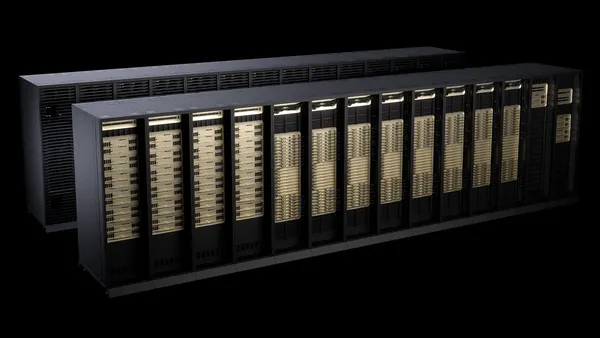
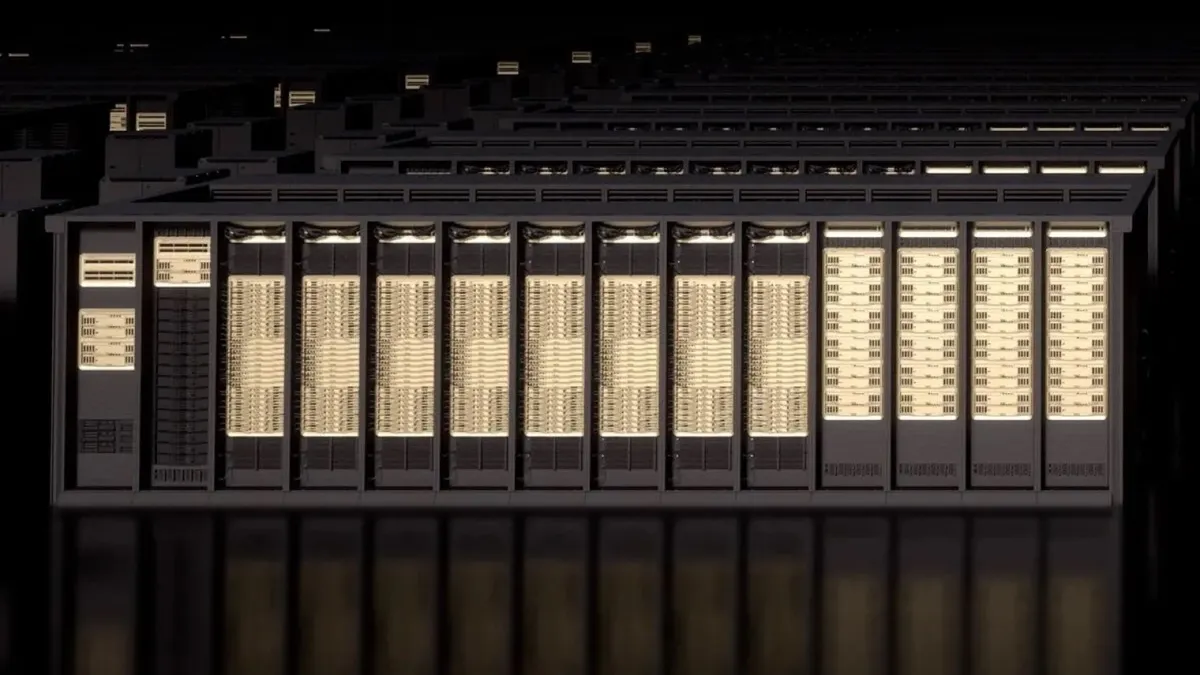
The platform maintained above 97% overall scaling efficiency when expanding from 256 to 1,024 GPUs on DeepSeek-V3. Inside each NVL72 rack, 72 GPUs and 36 CPUs are connected through a copper NVLink 6 spine delivering 3.6 TB/s per GPU and 260 TB/s per rack. The system scales beyond the rack using ConnectX-9 SuperNICs over Quantum-X800 InfiniBand or Spectrum-X Ethernet.
What the results mean for developers
NVIDIA platforms held the fastest training time on every benchmark in MLPerf Training v6.1, according to NVIDIA, and were the only platforms to submit results across all seven benchmarks. Eighty percent of closed-division submissions ran on NVIDIA platforms across 20 partner organizations.
The results suggest that Vera Rubin’s gains extend across different model sizes, architectures and stages of development, from large-scale pretraining to reinforcement learning post-training for AI agents. NVIDIA says the platform’s systems are generally available through cloud infrastructure partners worldwide, giving developers a route to access the architecture without deploying their own systems.
NVIDIA Developer: NVIDIA Vera Rubin NVL72 Achieves up to 2x Blackwell Ultra Performance in MLPerf Training v6.1