Singapore Chief Justice: AI Must Not Replace Human Judgment in Courts
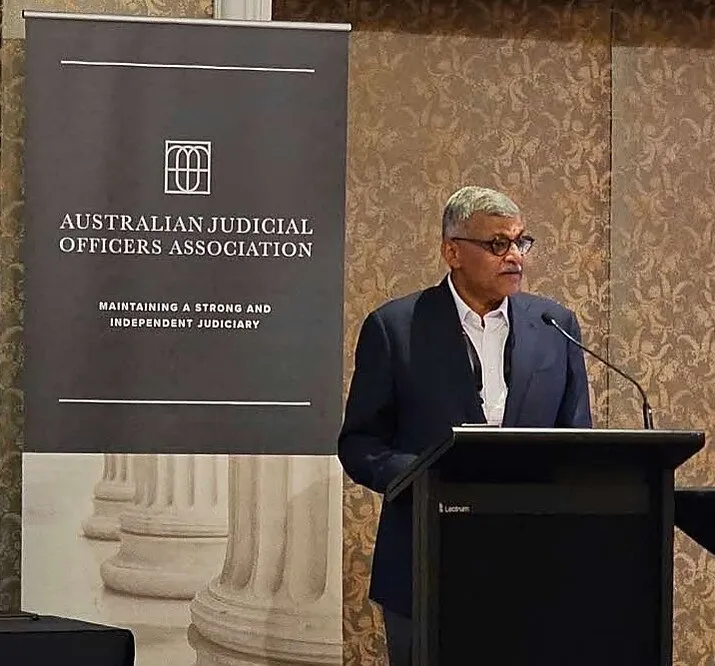
Singapore's Chief Justice Sundaresh Menon says AI can improve access to justice and judicial efficiency, but human judgment must remain central to the administration of justice. He made the case in a speech to Australian judicial officers in Brisbane.
- Chief Justice Sundaresh Menon spoke at the 28th Annual Australian Judicial Officers Association Colloquium 2026 in Brisbane on 9 October.
- He said AI can improve access to justice and efficiency, but human judgment must remain central.
- AI's case is strongest for acquiring information, more qualified for analysis and proposing outcomes, and most limited for formulating judicial reasons.
- He named three risks: over-reliance, skills fade and hidden institutional delegation.
- He argued for governing AI use rather than retreating from it.
A speech on the limits of artificial judgment
Chief Justice Menon of the Supreme Court of Singapore delivered the speech, titled "AI and the Judicial Function: The Limits of Artificial Judgment", at the 28th Annual Australian Judicial Officers Association Colloquium 2026 on 9 October in Brisbane, Australia.
He noted that AI has already entered the justice system through the parties, the profession and the tools used to administer the courts. The question he posed was how far judges should engage with AI, for what purposes, and on what terms.
His answer was that AI's role in adjudication should be calibrated to the nature of the judicial function involved. In his words, as summarised by the Supreme Court, the closer AI comes to exercising judgment, the greater the need for restraint.
Where AI fits in adjudication
Chief Justice Menon grounded his analysis in three requirements of sound adjudication: judicial integrity, procedural fairness and institutional effectiveness. Much of the case for judicial use of AI rests on effectiveness. Its attraction lies in scale, speed and baseline reliability, which seemingly lets courts serve more users, more quickly, while still producing outcomes that are generally correct. But effectiveness alone cannot justify every use, he said.
To weigh the trade-offs, he suggested breaking adjudication into its working parts and identifying the values engaged by each. On that basis:
- The case for AI is most compelling where it is used to acquire information.
- The case is more qualified where AI analyses that material or proposes outcomes.
- The case is most limited where AI formulates judicial reasons.
Design, governance and the risks of collaboration
Beyond which uses may be acceptable in principle, the Chief Justice stressed that questions of design and governance were no less important. He cautioned that a sound use of AI can be rendered unsafe by the design of the tool, the structure of the workflow or the habits of the user.
He drew attention to three risks of human-machine collaboration: over-reliance, skills fade and hidden institutional delegation. The answer, he said, was not to retreat from AI but to govern its use in ways that preserve meaningful human judgment and control. He offered five observations on what this might involve in practice. The source does not list them.
What it means for courts
Chief Justice Menon concluded that while AI may seem highly intelligent, it is inescapably artificial. It cannot bear judicial responsibility, nor replicate the human encounter at the heart of a fair hearing. In adjudication, he said, being human is not a deficiency to be minimised. In many ways, it is precisely the point.
For courts weighing AI tools, the speech offers a framework rather than a ban: use is easiest to justify for gathering information and hardest to justify for writing reasons, and every deployment needs safeguards against over-reliance and quiet delegation of decisions. The full speech is available from the Supreme Court of Singapore.