Tuya Open Sources Skill for Controlling Smart Home Devices Through Meta Muse
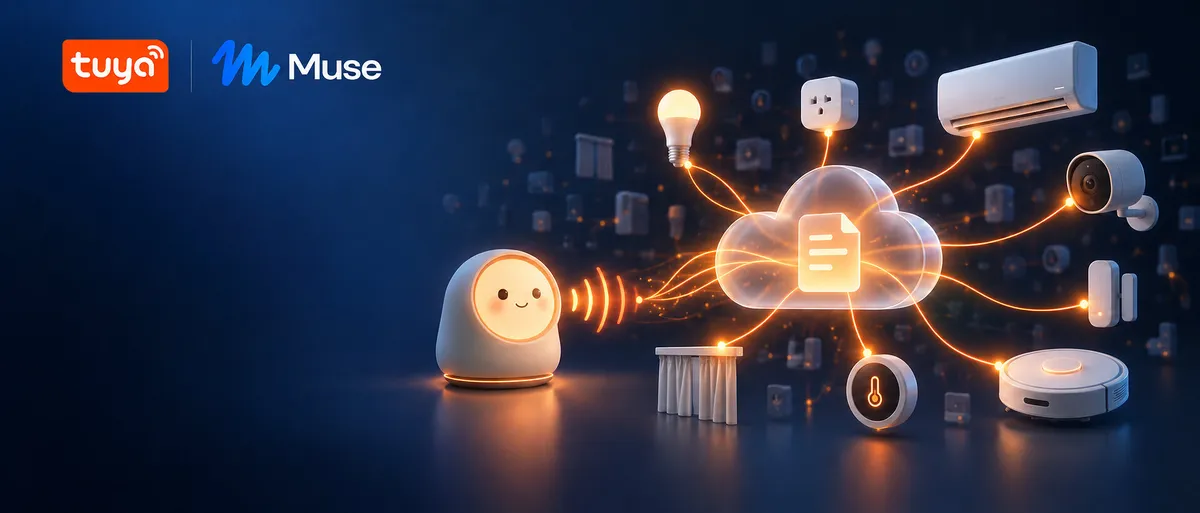
Tuya has released Tuya Cloud Devices, an official open-source skill that lets Meta’s Muse personal AI agent query and control Tuya smart devices using natural language. The cloud-based connection requires a single API key, rather than local device keys, shared-network access or firmware changes.
- Tuya released the open-source Tuya Cloud Devices skill for Meta Muse.
- The skill uses one API key and Tuya’s cloud instead of local device keys.
- It supports natural-language control across more than 3,000 smart hardware categories.
- Muse can handle device queries, alerts, camera media and event-driven automations.
- Safety measures include confirmation requests, status checks and restricted operations.
Cloud access connects Muse to existing devices
The skill, whose name is gadget-tuya-cloud-devices, is derived from Tuya’s official open-source AI skill, tuya-smart-control. Tuya says its engineers adapted the skill to match the Muse Gadgets specification and released it as a simple Markdown file.
Muse provides conversational and agent functions, while Tuya supplies connectivity to devices already linked to a user’s Tuya account. Users can request a free API key through Tuya AI at tuya.ai. The skill uses the key to select the correct API endpoint from seven Tuya data centers, without requiring manual configuration.
According to Tuya, the platform covers more than 3,000 smart hardware categories and serves more than 200 countries and regions. As of June 30, 2026, the company reported more than 2.09 million registered AI developers.
Natural-language controls and automation
Tuya Cloud Devices is designed to support everyday requests such as dimming a living-room light or checking whether a bedroom light is on. Muse can also list devices in a room, rename a sensor, answer questions about device data and provide information such as an air conditioner’s electricity use from the previous day.
Users can request alerts when conditions change. Tuya says notifications can arrive by SMS, voice call, email or app push notification. The skill can also request a camera snapshot, returning a photo or a video of up to 60 seconds.
For event-driven automation, users can create rules such as turning on a hallway light when a door opens. Tuya says real-time events require an always-online Linux device that can receive event subscriptions. A Raspberry Pi connected to Muse can run a subscription program that monitors device-property and online or offline changes, then carries out user-confirmed trigger-action rules.
Safety limits are built into the skill
The skill asks for confirmation when a request matches multiple devices and identifies the rooms where those devices are located. It reports offline devices without sending commands, avoids read-only properties and keeps values within the ranges and increments defined by each device’s model.
After issuing a command, it reads the device status again one to two seconds later and confirms the change only after checking that it took effect. Event-triggered notifications are sent at least 30 minutes apart to reduce alert fatigue.
Tuya Cloud Devices does not provide operations such as door-lock control, live video, firmware updates, network configuration or device removal. The company says those requests are directed to the Tuya app. The API key is treated as a credential, used only in request headers and limited to devices associated with the user’s account.
The release extends Muse Gadgets, Meta’s open-source hardware interface for building devices with Wi-Fi MCU development boards or Raspberry Pi. Tuya says the skill was first developed for the open-source agent OpenClaw and adapted for Muse, allowing device capabilities in the Markdown SKILL.md format to be reused across agents.