Tuya Open-Source Skill Lets Meta Muse Control Smart Home Devices
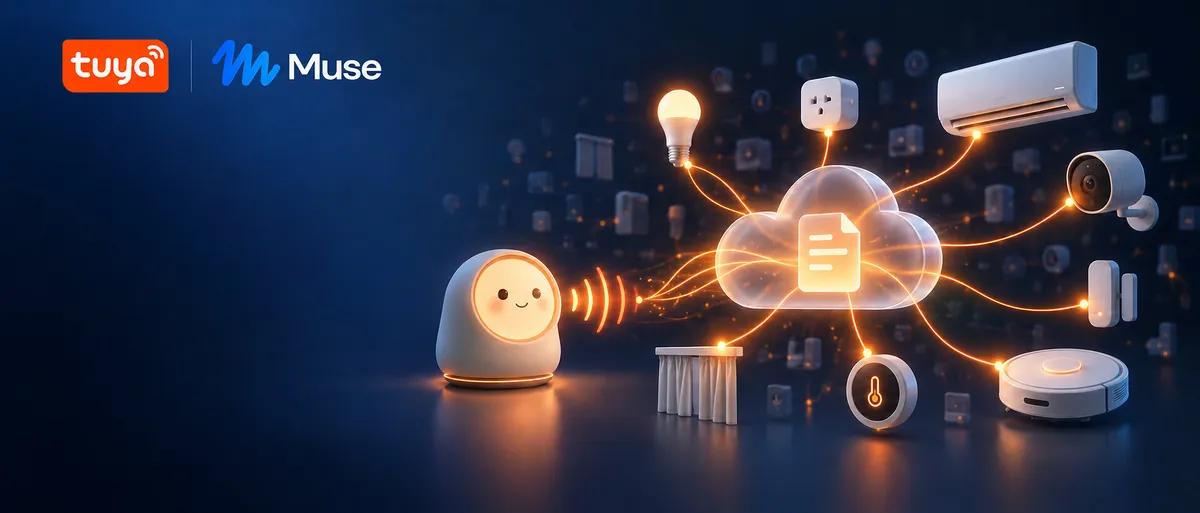
Tuya has released Tuya Cloud Devices, an official open-source skill that lets Meta's Muse AI agent query and control connected home devices using natural language. The cloud-based integration works with a single Tuya API key and does not require local device keys, a shared local network or firmware changes.
- Tuya Cloud Devices is an official open-source skill for Meta Muse.
- The skill uses one Tuya API key and cloud access to control connected devices.
- It supports natural-language queries, alerts, snapshots and trigger-action automations.
- Safety measures include confirmation for ambiguous devices and post-command state checks.
- Tuya says its platform covers more than 3,000 connected hardware categories.
A cloud link between Muse and existing devices
Tuya Smart said the skill, named gadget-tuya-cloud-devices, gives Muse access to devices already connected to a user's Tuya account. Muse can handle requests involving lights, plugs, air conditioners, cameras and sensors, rather than limiting users to hardware specifically built as an AI accessory.
The skill is based on Tuya's open-source tuya-smart-control AI skill and is written as a Markdown file that follows the Muse Gadgets specification. Tuya said it adapted the skill for Muse and released it as open source.
According to the company, existing community solutions often require a local key for each device, along with details about the device's communication protocol and data-point definitions. Reconnecting a device to the network can invalidate its key. Tuya Cloud Devices instead communicates through the Tuya cloud, removing those requirements.
Natural-language controls and automations
Users can ask Muse to control devices or check their status with ordinary language, such as lowering a living-room light or asking whether a bedroom light is on. The skill can also list devices in a home or room, rename a sensor, and answer questions such as how much electricity an air conditioner used the previous day.
Tuya said users can request alerts when device conditions change. Notifications are sent only to the user through SMS, voice call, email or an app push notification. Muse can also request a snapshot and return a photo or a video lasting up to 60 seconds.
The integration supports trigger-action automations, such as turning on a hallway light when a door opens. Real-time events and event-triggered notifications require an always-connected Linux device. Tuya said Muse Gadgets' Linux SDK can run a resident subscription program on a Raspberry Pi to receive property and online or offline changes continuously.
The skill reads each device's standardized object model before generating a command. It uses the model's read and write permissions, value ranges and increments, allowing one skill to support a broad range of product categories without adapting it for every model.
Safety controls are built into the integration
Tuya said the skill asks users to confirm when multiple devices match a request, including by listing the rooms where those devices are located. It reports when a device is offline rather than sending commands, does not write to read-only properties, and keeps values within the ranges and increments defined by the device model.
After sending a command, the skill checks the device state one to two seconds later and confirms the change only after verifying that it was applied. Device-event notifications are sent at least 30 minutes apart to reduce repeated alerts.
The skill does not expose operations for door-lock control, live video, firmware updates, network configuration or device deletion. Tuya said those requests are redirected to its app. The API key is treated as authentication, used only in request headers and never returned in the conversation. It provides access only to devices linked to the user's account.
Why the broader device platform matters
Tuya said its platform covers more than 3,000 connected hardware categories and serves more than 200 countries and regions. As of June 30, 2026, the company reported more than 2.09 million registered AI developers.
The company positions Tuya Cloud Devices as a connection between experimental Muse Gadgets, which developers can build with commercially available hardware, and mass-produced connected devices that remain in homes over the long term. Once a device is connected to Tuya's AI cloud platform, its object model, cloud services and account system are already in place, allowing an agent to access it without a firmware change.
Tuya also said the skill was initially designed for OpenClaw, an open-source agent, and works with Muse after adaptation to the Muse specification. That portability could allow device capabilities to be reused across agents that adopt Markdown skills in the SKILL.md format, according to the company.