Vaughn College Hosts Sixth International Conference on Digital Technologies
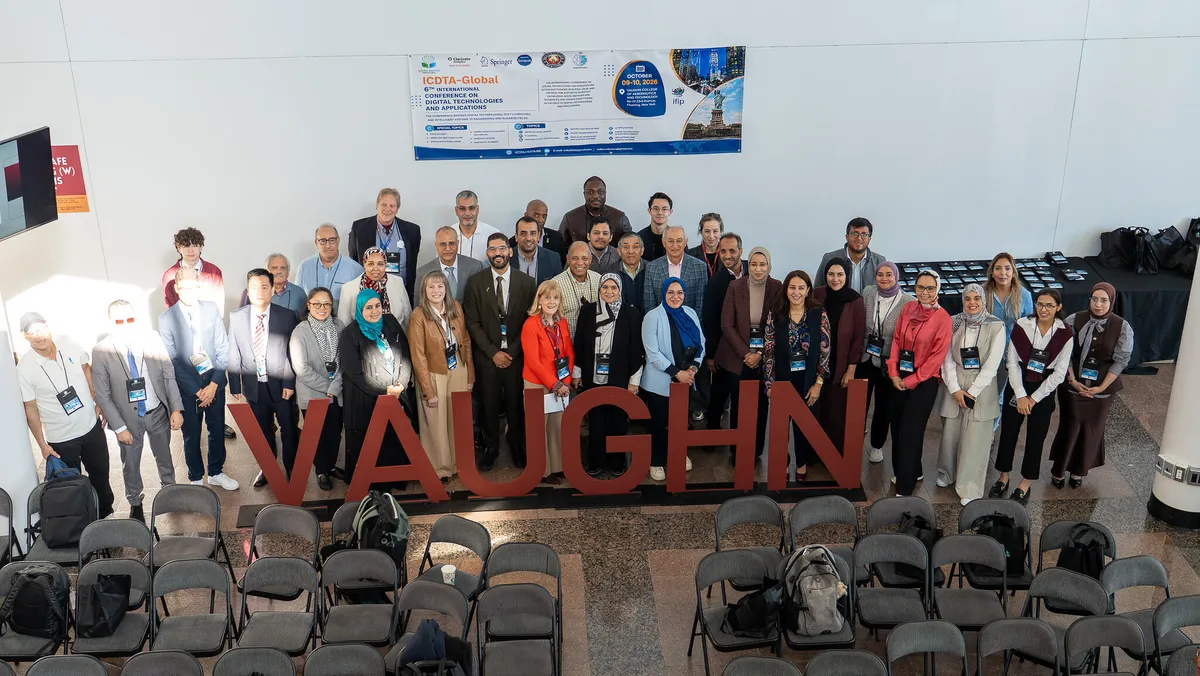
Vaughn College in Queens, New York, hosted the sixth annual International Conference on Digital Technologies and Applications (ICDTA) on October 9 and 10, drawing researchers from more than 30 countries. The two-day hybrid event focused on digital technologies, soft computing and intelligent systems.
- Vaughn College hosted the sixth annual ICDTA on October 9 and 10, 2026, in a hybrid format.
- Researchers from more than 30 countries took part in person and online.
- Plenary speakers came from Predictum Inc., IBM, Nile University and CUNY College of Staten Island.
- Topics included efficient LLM inference, FPGA accelerators and responsible AI for marketing.
- Dr Sanaa Faquir said the event created publication ties and opened doors to partnerships and grants.
A hybrid event with global reach
According to the college, the conference served as a bridge between high-level engineering and practical business applications. Researchers took part both in person and online, and came from more than 30 different countries.
Dr Sanaa Faquir, assistant professor in Vaughn's engineering and technology department, served as a conference moderator and also helped organize the event. She said hosting the conference "significantly elevated the institution's global academic presence while providing students with invaluable professional growth." She added that the college established indexed publication ties and opened the door for future institutional partnerships and research grants.
Plenary sessions on research quality, LLMs and responsible AI
The in-person part of the conference consisted of two plenary sessions on October 9. The morning session featured Wayne J. Levin, president and chief executive officer of Predictum Inc., Canada, and Dr. Philip Ramsey, vice president of data science and training at Predictum. They discussed how bad research costs the United States economy several billion dollars every year, and what steps could reverse the trend.
The morning session closed with Dr. Kaoutar El Maghraoui, principal research scientist at IBM, who spoke on efficient LLM inference. The release describes this as the process of using a trained large language model to generate output text, code or data from an input prompt without changing the model's learned weights.
The afternoon session opened with Dr. Lobna A. Said, professor at Nile University. She discussed hardware-efficient FPGA accelerators for a machine learning-based time-series. The release explains these as hardware circuits built on a field-programmable gate array that speed up scientific computing tasks by executing them directly in parallel custom logic.
The session ended with Dr. Amir Toliyat, assistant professor of information systems and informatics at City University of New York City-College of Staten Island, who spoke about responsible AI for marketing decision support.
Online sessions across many sectors
Online participants heard both plenary panels on October 9 and attended oral sessions on October 10. These covered AI and the digital transformation of the workplace, and the impact of AI on healthcare, business, marketing, education, aviation and several other fields. They also addressed the digital transformation of supply chains, health, education, energy, power grids, government and power sectors.
About Vaughn College
Founded in 1932, Vaughn College is a private, nonprofit four-year college. It enrolls more than 1,600 students in master's, bachelor's and associate degree programs in engineering, technology, management and aviation, on its main campus in New York City and online. The college reports a student-faculty ratio of 18 to 1.
It also states that 95 percent of its graduates, 71 percent in their field of study, are employed in professional positions or continue their education within one year of graduation. The institution serves many first-generation college students and is recognized by the US Department of Education as a Hispanic-Serving Institution.
What it means
For Vaughn College, the conference is a way to build its research profile. Faquir pointed to publication ties, possible partnerships and research grants as outcomes. For students, the event brought researchers and industry speakers directly to campus, according to the college.