Daytona Says It Went From $1M to $100M Run Rate in Four Quarters
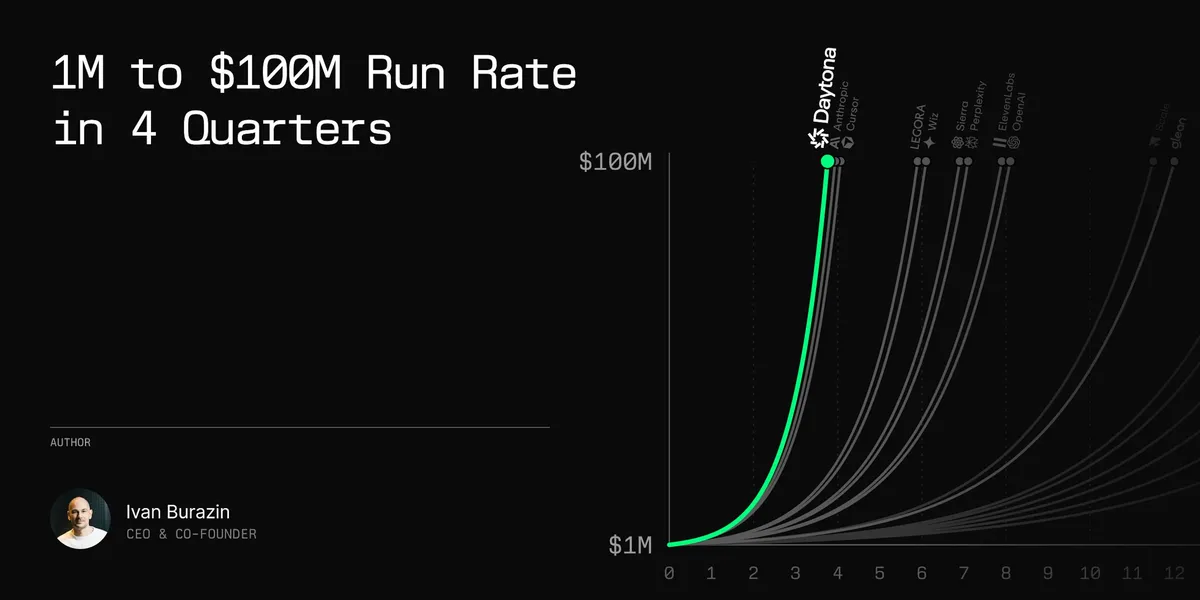
Daytona, a startup that provides cloud computers for AI agents, says it grew from a $1M run rate to $100M in four quarters. CEO and co-founder Ivan Burazin wrote that the company grew 37.5x this year alone.
- Daytona says it went from a $1M to a $100M run rate in four quarters, growing 37.5x this year.
- CEO Ivan Burazin says the $100M figure was a projection seen ten days into October.
- The company rebuilt its product for AI agents after handing old customers to competitors, with a few months of runway left.
- Daytona describes its product as an Agent Execution Cloud with fast startup, persistent state, forks, snapshots and per-second billing.
- Burazin compares the pace to Anthropic, Cursor, Mercor and other fast-scaling AI companies.
A pace that compares with the fastest AI companies
According to Burazin, Daytona's projected run rate showed $100M ten days into October. He acknowledged it was a projection and that there was still a real chance the company would not finish the month at that level. He sent a screenshot to the board and the team anyway.
Burazin places the result against a changing benchmark. He cites ICONIQ research saying software companies used to take five or more years to cross the stretch from $1M to $100M, and that its 2026 State of Scaling report shows AI-native companies reaching $100M ARR in one to three years.
He lists other companies on that curve, according to his post:
- Anthropic went from essentially zero to $100M in annualized revenue in 2023, in about a year.
- Cursor went from $1M to $100M ARR in roughly 12 months.
- Mercor crossed $100M 11 months after $1M.
- Legora and Wiz each took about 18 months.
- Sierra hit $100M ARR seven quarters after launch.
- Perplexity and ElevenLabs each took about 20 months.
- Glean took about three years.
Burazin writes that Daytona lands next to Anthropic, just under four quarters. He calls sharing a lane with Anthropic on this one metric "humbling more than it is loud."
Why agents need their own kind of cloud
Burazin's explanation is that agents need somewhere to run. In his words, models think on GPUs while work happens on CPUs. Each time an agent writes code, opens a browser, installs a package or forks a long-running job, it needs a machine that is isolated, fast, stateful and available through an API.
He argues that existing cloud infrastructure was built for human-shaped workloads: start a VM, wait, and run the same thing the same way. Agents behave differently, according to the post. They spin up thousands of environments, pause and resume, explore branches in parallel, and need startup in tens of milliseconds rather than minutes.
Daytona itself started as automated development environments for human engineers. When agents arrived, Burazin says customers told the company bluntly that its product was not what they needed. The company then handed its old customers to competitors, rebuilt from first principles, and relaunched with a few months of runway left.
The result is what Daytona calls an Agent Execution Cloud. Burazin lists instantaneous startup times, persistent state, forks and snapshots, and per-second billing that matches how agents use compute. He says the demand came from people building agents who wanted a real computer for every agent, covering code execution, computer use and reinforcement learning.
Growing pains and what comes next
Burazin describes the past year as less a victory lap than an effort to keep the floor from collapsing under the people who trusted the company. He points to capacity, support, hiring and explaining to investors why agents need a different cloud. He also notes that reinforcement learning and evaluation traffic went from almost nothing to a huge share of usage, with square-wave spikes that no classical capacity model was designed for.
He thanks investors FirstMark, Pace and Upfront, along with angels, early customers and co-founders Vedran and Goran. He says customers building on Daytona range from YC companies to labs and Fortune-scale teams.
Looking ahead, Burazin cautions that a run rate is not a destination and does not mean the hard part is over. His view is that models will keep improving and the bottleneck will move to the computer underneath. "Every agent that can think still needs a place to work," he writes. The company says its job is to keep those computers fast, safe and elastic.
The figures are the company's own claims in a post by its CEO, and the $100M number is a run rate, not reported revenue. For the market, the post points to growing demand for infrastructure built specifically for agent workloads rather than human-driven ones.
Daytona: 1M to $100M Run Rate in 4 Quarters